USAID DEC
Client and provider preferences for HIV care: Implications for implementing differentiated service delivery in Thailand
Sign inUSAID DEC
Client and provider preferences for HIV care: Implications for implementing differentiated service delivery in Thailand
The study aimed to assess the preferences for HIV care and attitudes towards differentiated service delivery (DSD) for antiretroviral therapy (ART) maintenance among ART clients and providers at healthcare facilities in Thailand.
2021 · 11 pages
Sign in to readA free account is required to download.
Abstract
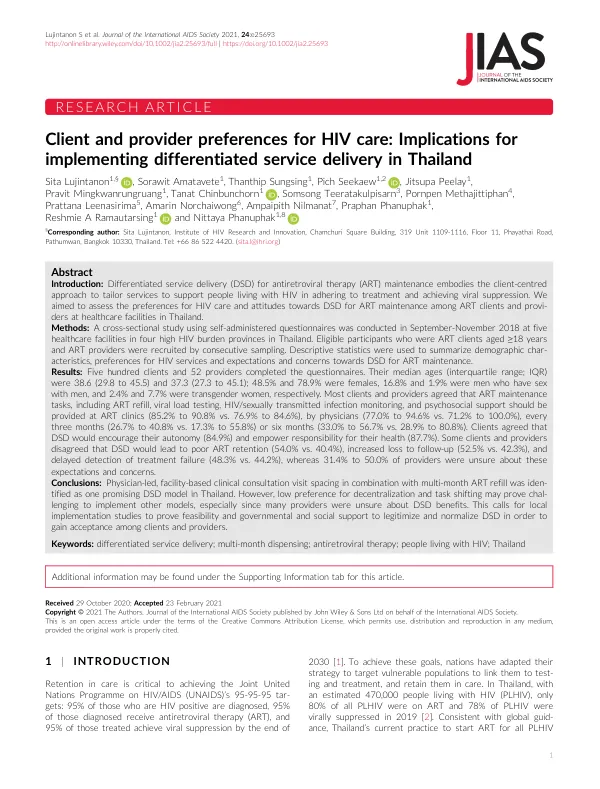
A cross-sectional study using self-administered questionnaires was conducted in September-November 2018 at five healthcare facilities in four high HIV burden provinces in Thailand. Eligible participants who were ART clients aged ≥18 years and ART providers were recruited by consecutive sampling. The study found that 500 clients and 52 providers completed the questionnaires. The median ages of clients and providers were 38.6 (29.8 to 45.5) and 37.3 (27.3 to 45.1) years, respectively. The majority of clients and providers agreed that ART maintenance tasks, including ART refill, viral load testing, HIV/sexually transmitted infection monitoring, and psychosocial support, should be provided at ART clinics, by physicians, and at regular intervals. Clients agreed that DSD would encourage their autonomy and empower responsibility for their health. However, some clients and providers disagreed that DSD would lead to poor ART retention, increased loss to follow-up, and delayed detection of treatment failure. The study identified a promising DSD model in Thailand, which involves physician-led, facility-based clinical consultation visit spacing in combination with multi-month ART refill. However, low preference for decentralization and task shifting may prove challenging to implement other models, especially since many providers were unsure about DSD benefits. The study highlights the importance of understanding the preferences of ART clients and providers in order to create differentiated models that are acceptable and meet their needs. The findings suggest that DSD models that prioritize client-centredness and flexibility may be more effective in maintaining ART adherence and improving health outcomes among people living with HIV in Thailand. The study's results also emphasize the need for local implementation studies to prove the feasibility of DSD models and to gain acceptance among clients and providers. The study's methodology involved a cross-sectional design, with a sample size of 500 clients and 52 providers. The study sites included five healthcare facilities in four high HIV burden provinces in Thailand. The study was approved by the Chulalongkorn University Institutional Review Board, Chiang Mai Provincial Public Health Office, and Research Ethics Committee of Hatyai Hospital. The study participants received compensation for their participation, with clients receiving 300 baht (US$10) as travel compensation and providers not receiving any compensation. The study's findings have implications for implementing DSD models in Thailand, particularly in terms of decentralization and task shifting. The study's results suggest that DSD models that prioritize client-centredness and flexibility may be more effective in maintaining ART adherence and improving health outcomes among people living with HIV in Thailand. The study's methodology and findings provide a foundation for future research on DSD models in Thailand and other countries.
Related documents

![Evaluation of the US-Asia environmental partnership [US-AEP]](https://covers.devme.ai/gen/5422.webp)