USAID DEC
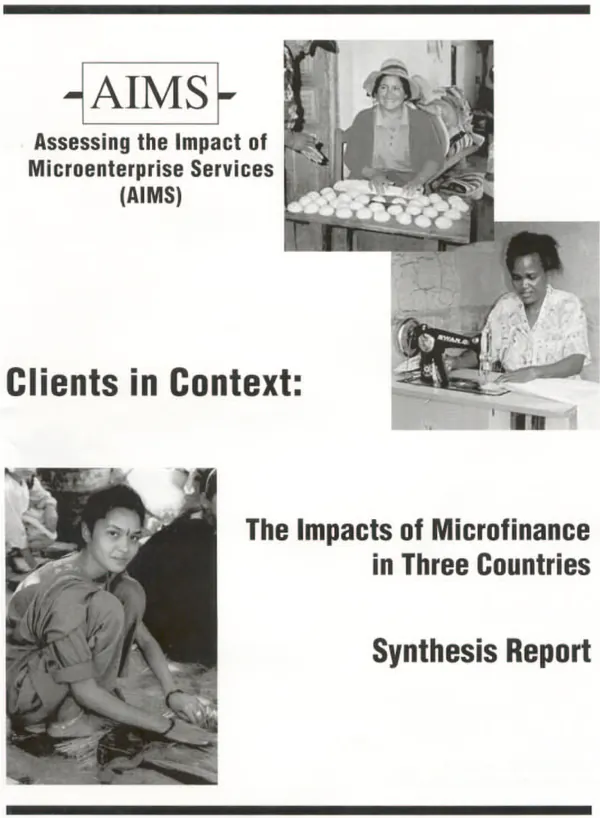
Clients in context : the impacts of microfinance in three countries : synthesis report
Sign inMANAGEMENT SYSTEMS INTERNATIONAL, INC. (MSI)
Clients in context : the impacts of microfinance in three countries : synthesis report
This report summarizes case studies of impacts at the household, enterprise, and individual levels of three microfinance institutions (MFIs): SEWA Bank in India (PN-ACN- 571); Accion Communitaria del Peru/Mibanco in Peru (PN-ACN-573); and Zambuko Trust in Zimbabwe (PN-ACN-575).
Snodgrass, Donald R.; Sebstad, Jennefer · 2002
Sign in to readA free account is required to download.
Abstract
Overall, microfinance makes a difference, though no single impact was found uniformly in all three countries. Use of microfinance benefitted household income in India and Peru, but not in Zimbabwe. It encouraged diversification of income sources in Peru and Zimbabwe, but not in India. It led to limited increases in expenditures on household assets: repeat borrowers spent more on housing improvements and consumer durables in India; in Zimbabwe, clients as a whole spent more on durables, but not on housing improvements. Food consumption by the poor was positively affected in Peru (by a small amount) and Zimbabwe, but not in India (except perhaps for repeat borrowers). Program participation promoted school enrollment for boys in all three countries, but for girls only in Peru. There was only limited impact on household ability to cope with financial shocks. The studies show that people from poor households do participate in microfinance programs and benefit in a number of important ways. Yet microfinance seems to have very modest impacts on the overall incidence of poverty among clients. In terms of gender, all the programs studied were conducted with high levels of gender awareness. A majority of clients in all three programs are women, so program benefits tend to go to women, though variously. Most differences in impact appear to be related to differences in enterprise types, household structure, composition of economic portfolios, and economic goals. The studies document various ways in which low- income urban households use credit and savings to manage risk. Important strategies to protect against risk ahead of time are income smoothing, building financial assets, and maintaining access to multiple sources of credit. Respondents in all three countries borrow mostly from informal sources in times of need. Microfinance helps protect against enterprise risks, primarily through diversification that reduces seasonal variations in income and through improvements in transactional relationships. Individuals and households use a variety of strategies to manage financial shocks after they occur. They modify consumption, raise their income, or sell assets. Microfinance plays a smaller role in coping with risks after they occur than in helping clients protect against risk ahead of time. Major themes include the following: (1) Microfinance reaches down and benefits the near-poor, the moderately poor, and even the extreme poor, with similar impacts on all three groups. It helps some people escape poverty, but borrowing entails significant risk and the climb out of poverty tends to be slow and uneven. (2) Microfinance and household resources are highly fungible. Contrary to a widespread assumption that borrowers invest loan proceeds in microenterprises and repay their loans out of the additional revenue generated by these investments, clients often use the additional resources generated by borrowing for purposes other than microenterprise development and repay their loans from various financial resources. MFIs are only one source of finance, yet they significantly broaden the range of economic options open to microentrepreneurs and poor households. (3) Microfinance is a valuable vehicle for empowering the poor, especially women and thus promotes gender equity and improves household well-being. (4) Context (economic conditions, program characteristics, length of participation in the program) makes a difference. Strategies for increasing the impact of microfinance programs include expanding services, tailoring products and services to client needs, developing protective mechanisms such as insurance and social benefits, adding business and management training, providing housing loans, and introducing voluntary savings programs, insurance, and emergency loans. Some of these changes have already been made by the MFIs as a result of their participation in the impact study.
Related documents
![Microfinance and mitigation of the impacts of HIV/AIDS : an exploratory study from Zimbabwe[ -- summary]](https://covers.devme.ai/gen/49010.webp)
![Managing resources, activities, and risk in urban India : the impact of SEWA [Self-Employed Women"s Association] Bank](https://covers.devme.ai/gen/72856.webp)