INTERNATIONAL SCIENCE AND TECHNOLOGY INSTITUTE, INC. (ISTI)
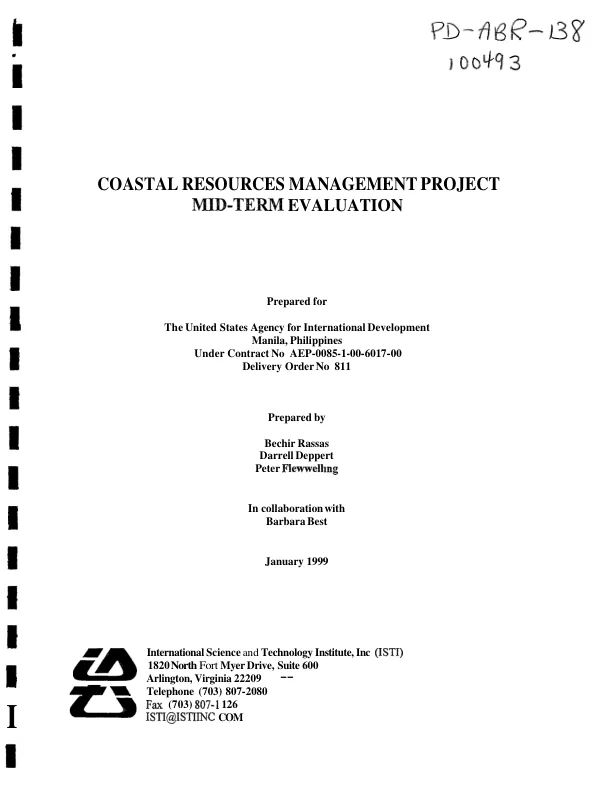
Coastal resources management project : mid-term evaluation
Evaluates project to apply a community-based coastal resource management (CRM) approach in addressing the problems of overfishing and the imminent collapse of fisheries in Philippine coastal waters.
Rassas, Bechir|Deppert, Darrell · 1998
Sign in to readA free account is required to download.
Abstract
Operating in Palawan, the Visayas, and Mindanao, the project focuses on fishers in municipal waters and on local government units (LGUs), which have administrative jurisdiction over coastal resources. Interim evaluation covers the period 1996-1/99. The Department of Environment and Natural Resources (DENR) is the implementing agency, with Tetra Tech EMI, Inc., the prime contractor. Major project achievements to date are as follows: (1) The project has developed a reputation throughout the country and the donor community as a source of state-of-the-art knowledge of CRM implementation. (2) Interviews conducted for this evaluation, as well as the high degree of cohesiveness and unity observed among fishers in most areas visited, suggest that the project has significantly increased awareness of the importance of resource conservation and protection among the coastal communities in which it operates. The CRM concept is now widely accepted in most project learning sites and is expanding to other barangays and municipalities. (3) The project has provided impetus to new and innovative CRM policy and thought at both the national and LGU levels. (4) The project has helped create a wider agreement among officials that community stakeholders must play a substantial role in resource development and management. (5) The project has used a participatory approach to assist community group members in analyzing their constraints and opportunities. Participants at all levels are appreciative of its approach and potential impact. (6) The project has increased awareness of the resource depletion problem among stakeholders, thereby stimulating active participation in CRM activities. Organized participants at all levels are beginning to experiment enthusiastically with their new roles and responsibilities. (7) The project has made considerable progress in institutionalizing CRM implementation within the LGU structure. (8) The project has also stimulated a synergy between national and local CRM initiatives to ensure both that local initiatives are consistent with national policy and that national policy is responsive to field-level needs. (9) The project has been instrumental in including CRM as an integral part of the food security initiative in the Philippines. This effort will enable LGUs (identified in the 1998 Agricultural and Fisheries Modernization Act as the stewards of food security) to include a CRM plan for achieving food security. The project, now about half over, is at a crucial point of implementation, and its achievements will not be sustained if the remaining project tasks cannot be completed. A 2-year extension to ensure project institutionalization is therefore highly recommended. This is consistent with the project design, which viewed the project as a 7-year, not a 5-year effort. (Author abstract, modified)