URBAN INSTITUTE (UI)
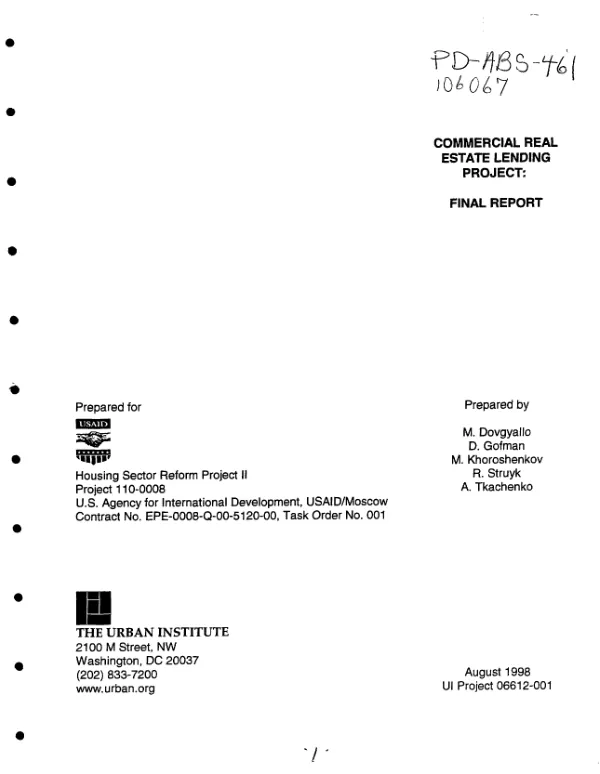
Commercial real estate lending project : final report
Final report of the Urban Institute on a contract to promote commercial real estate lending (CREL) in Russia (DURER project).
Dovgyallo, M.; Gofman, D. · 1998
Sign in to readA free account is required to download.
Abstract
The project ran from 1995 to 8/98 and was implemented until August 1996 by the Barents Group. At the start of the project, an analysis of the current condition of the Russian CREL market was undertaken, and several key indicators identified, specifically: the level of interest rates on bank loans; the legal environment; the need to develop a bank system for CREL; and the structure of bank assets. The changes in these indicators during the course of project implementation were positive. Project efforts were devoted primarily to: (1) developing a series of guidelines and methodological materials ready for immediate use by Russian banks, including a spreadsheet program for project analysis, model legal forms, and guides on market analysis and loan dispersal policies; (2) providing onsite consultation to participating banks, wherein the specifics of actual loan applications could be addressed; and (3) providing multiple offerings of the two project-developed training courses for bank and real estate professionals, along with presentations at numerous seminars organized by other organizations for similar audiences. The project exceeded the benchmarks set for it in the Task Order: (1) A total of 37 banks participated in the project and used the mortgage package it developed, vs. a target of 25; all of these banks received onsite consultation. (2) About 400 bankers and real estate professionals received some form of training from the project, compared with a goal of 200. (3) The project developed a highly detailed guide for lenders making commercial real estate loans as indicated by the Task Order and also produced three other guideline documents. The overall conclusion is that, in spite of existing problems, CREL became a reality of banking practices in Russia. Bankers have started to understand that they lack experience in this particular sphere mostly due to the absence of developed CREL technologies and procedures and the lack of highly qualified personnel. As a result of the project, bankers" interest in funding construction and development of commercial real estate has grown. A major factor contributing to the development of mortgage lending is the willingness of legal departments within banks to find innovative ways of tackling existing problems and their ability to adopt new thinking. Within the near future, after financial situation in Russia becomes more stable, a sharp growth in the number of loans secured by commercial real estate is expected. Russian banks have started to use classical schemes of mortgage lending on an everyday basis. (Author abstract, modified)
Related documents