JOHN SNOW, INC. (JSI)
Commodity security for essential medicines : challenges and opportunities
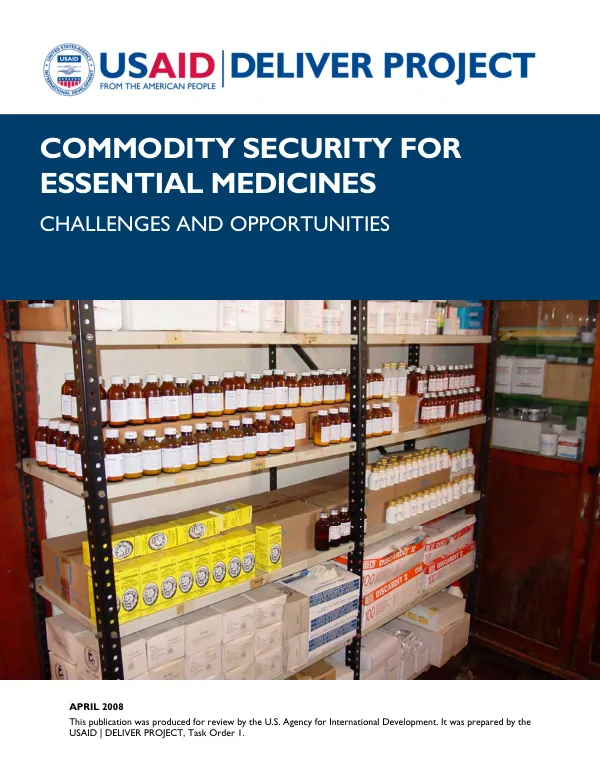
Commodity security exists when clients can obtain and use essential health commodities when and where they need them.
Rao, Raja · 2008
Sign in to readA free account is required to download.
Abstract
This concept is an extension of earlier frameworks that were first developed for family planning and reproductive health commodities and later for HIV/AIDS commodities. The systems, functions, and policies identified in these frameworks -- necessary for reproductive health or HIV/AIDS commodity security -- are also at the center of the World Health Organizations" (WHO) essential medicines strategy. Commodity security (and its program-specific antecedents) and the WHO essential medicines strategy is a starting point from which to shape coordinated and integrated approaches to improve the availability of essential health supplies. By reviewing the program-specific approaches that have been used to date, many lessons can be learned to improve availability and access. The integration of distribution systems, health services, financing sources, and policy frameworks can also be a useful strategy to strengthen commodity security for multiple categories of essential medicines. The solution, however, is not all or none. Programs can strengthen commodity security by integrating one, some, or all these functions. Advantages and disadvantages exist to both product-specific (i.e., vertical) and integrated approaches. However, global and country-level trends are pointing toward a systems view of health services, which tends to support a multi-product category, integrated approach to commodity security. (Author abstract)