UNIVERSITY OF CALIFORNIA AT BERKELEY. CENTER FOR SOUTHEAST ASIA STUDIES
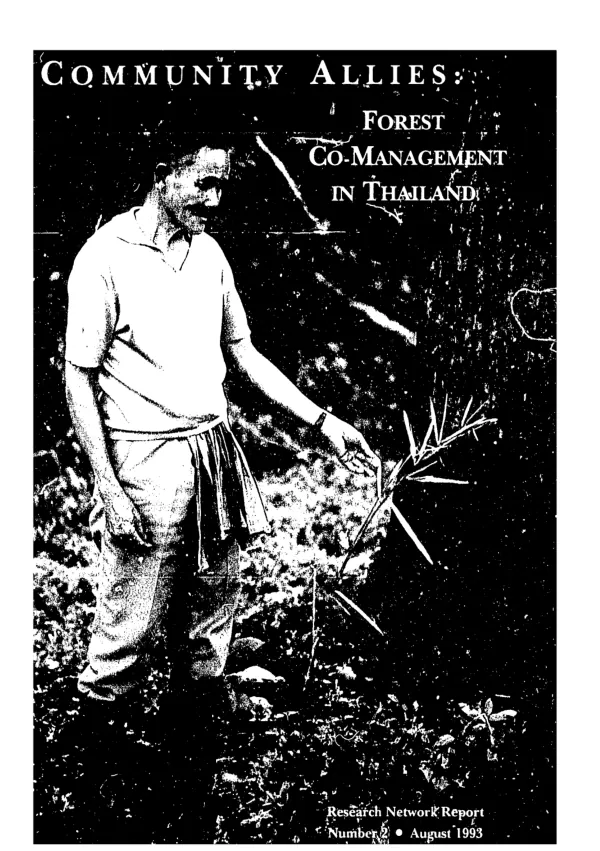
Community allies : forest co-management in Thailand
Thailand has experienced rapid deforestation over the past three decades, reducing its forest cover by half.
Poffenberger, Mark, ed.; McGean, Betsy, ed. · 1993
Sign in to readA free account is required to download.
Abstract
Despite the lack of a formal national policy framework which specifically acknowledges community rights and responsibilities in co-managing public forest lands, widespread, often spontaneous grass-roots initiatives have been taken by local communities to protect and manage their surrounding forests. A national inventory conducted by the Royal Forest Department (RFD) documents over 12,000 rural community groups protecting forest patches ranging in size from one to 4,000 hectares for a variety of religious, ecological, and economic purposes. Many of these activities are operating informally, some under pilot programs and others through local agreements between the Tambon (subdistrict) Council and the RFD. To increase understanding of locally appropriate systems of community forest management as an alternative to custodial, bureaucratic forest controls -- which have generally failed to control access -- applied, diagnostic research undertaken over the past two years has attempted to document the lessons emanating from selected field experiences. This monograph describes two different systems of community forest management, Dong Yai in the Northeast, and Nam Sa in the North. In both cases, rural communities and the RFD are breaking new ground by working together to regulate access to and regenerate degraded natural forests. In Dong Yai, former kenaf fields now under community protection have naturally regenerated into the largest remaining lowland stand of dry dipterocarp forest in the region: the case illustrates the persistent threats to the resource as it accrues value; the strong forest dependencies of Dong Yai"s twelve communities, especially on non-timber forest products; and, hence, the villagers" strong motivation in ensuring the sustainability of forest benefit flows into the future. The support and leadership provided by the Tambon Council, RFD"s regional forestry office, and researchers at Kasetsart University coalesced to create a climate in which communities led by village elders were empowered to organize into local forest protection committees and establish their own use rules and responsibilities for Dong Yai. In the northern subwatershed of Nam Sa, conflicts between midland and upland hill tribes based on unsustainable land-use practices were leading to rapid forest and environmental deterioration. The case highlights the incremental strategy of reducing social conflict by organizing microwatershed land-use committees and networking resident community groups through a coordinating forum. Tools such as ecological information and three-dimensional maps improved villagers" understanding of the importance of upstream-downstream watershed linkages. With the technical assistance of the RFD and the cooperation of the midland Karen people, Hmong and Lisu tribes are in the process of abandoning their steep-slope swidden practices and replacing them with upland forest protection and lowland, irrigated paddy cultivation. Decentralized controls over clearly defined microwatershed areas by organized local hamlets have reduced threats of fire, illegal logging, and upland erosion and are resulting in impressive natural forest regeneration. The communities of Dong Yai and Nam Sa are pioneers in a new age of participatory forest management. They are proving that their intimate involvement as allies, collaborators, and partners with the RFD forms what may well be the only sustainable foundation for the future protection and management of Thailand"s natural forests. (Author abstract)
Related documents