USAID. MISSION TO BOLIVIA
Community and child health
Summarizes mid-term evaluation (XD-ABD-773-A) of a project to reduce infant, child, and maternal mortality in Bolivia.
1992
Sign in to readA free account is required to download.
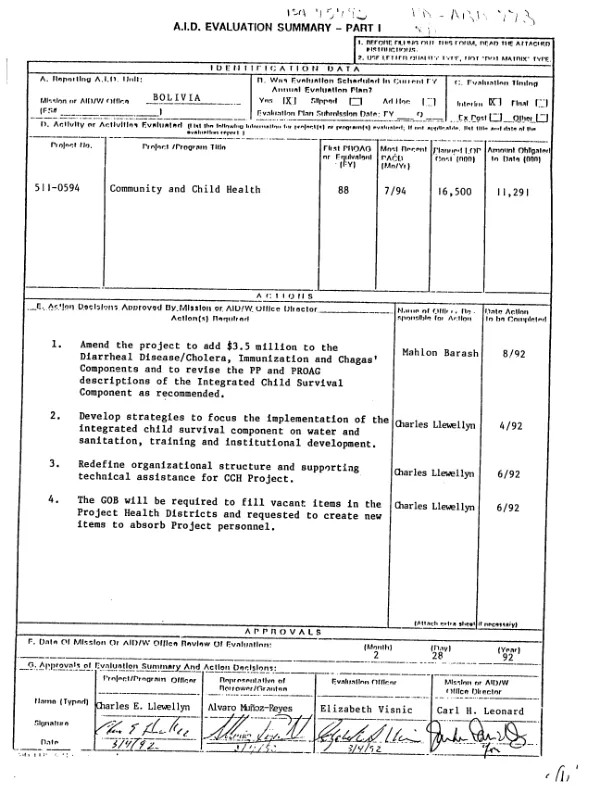
Abstract
The evaluation covered the period FY88-1/92. Project management has been complicated by several factors, including the combination of three distinct strategies under one management structure. The diarrheal disease component provides commodity support to existing Ministry of Health (MOH) programs. The integrated child survival component provides TA, training, commodities, and operational support to strengthen child survival and water and sanitation (W&S) interventions in selected health districts. The Chagas" disease control component is a pilot effort to identify models for preventing transmission of the disease. The consolidation of these three strategies has caused confusion concerning implementation priorities, organizational structure and functions, and the roles of the various implementing agencies. The project design underestimated the type and number of staff needed for financial management and procurement and overestimated the MOH"s capabilities to implement W&S activities. As a result, the contractor, John Short & Associates (JSA), was given both administrative and TA responsibilities; however, the JSA team did not arrive until early 1990, and subsequently the Chief of Party resigned prematurely (the post is still vacant). Financial and material resources have also been significantly delayed, in part due to inexperience with P.L. 480 accounting requirements. JSA has been overly burdened by administrative tasks at the expense of providing TA, and no advisors have been placed at the regional sanitary units. The integrated child survival component is currently assisting four health districts, with a fifth to be included in 1992 through a subcontract with Project Concern International. A very encouraging development has been the introduction of a W&S model which utilizes appropriate technologies, facilitates community participation in decisionmaking and management, and appears to be potentially sustainable. To date, 3 W&S systems have been completed and 16 are under construction, almost all by contracts with NGO"s. However, the methodology does not yet integrate the child survival intervention in community organization or health promotion and education as a unified coherent effort at the community level. Neither institutional development nor community participation have received the attention and focus needed to assure the sustainability of project benefits. Moreover, there are no plans to provide TA in developing a local self-financing mechanism. The Mission plans to extend the PACD to 7/95 and add $3.5 million to the diarrheal disease/immunization and Chagas" components. Lessons learned include the following. (1) W&S and child survival must be seen as completely interdependent if long-range impact on community health is to be sustained. (2) The most basic and indispensable resource in delivering primary health care services is the front-line health worker, sufficient in numbers and suitably trained. (3) TA needs at the district and area levels are very basic. Advances take place one step at a time, requiring continuous and flexible assistance. (4) Projects with diverse strategies and objectives often function more effectively under separate management structures. (5) Projects involving several autonomous implementing agencies require high levels of communication, coordination, and negotiation.