USAID. MISSION TO SOUTH AFRICA
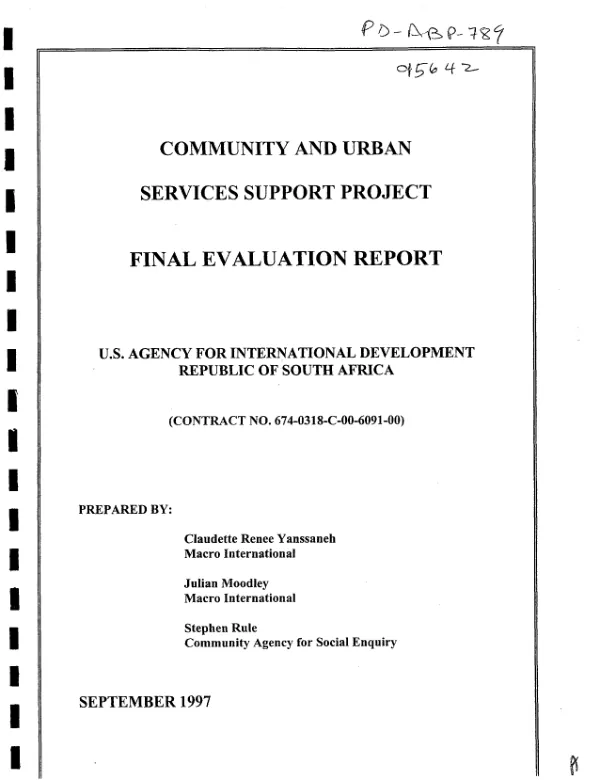
Community and urban services support project : final evaluation report
Final evaluation of a project (1992-9/97) to build the capacity of historically disadvantaged South African communities to deliver housing and related services (CUSSP project).
Yanssaneh, Claudette Renee|Moodley, Julian|Rule, Stephen · 1997
Sign in to readA free account is required to download.
Abstract
The project was implemented by Lance Bailey and Associates. The project was wide in scope, reaching communities and individuals in 8 of South Africa's 9 provinces with interventions that included technical advice on housing defects, negotiation and leadership training, development of upgrading strategies for informal settlements and hostels, and divestiture of state-owned accommodation units. The project achieved many of its objectives and its interventions were welcomed and appreciated by the majority of beneficiaries. Though the sustainability of several projects is evident, additional interventions are needed to ensure housing delivery for other communities. Key findings are as follows. In the community-based organization (CBO) institution-building component, training in leadership, bargaining, advocacy, and negotiations skills empowered a number of communities in their relations with provincial and local government and private sector building contractors. The mentoring program provided promising young black professionals greater insight into housing policy, finance, community mobilization, negotiation with stakeholders, organizational development, and project implementation. Career opportunities in the development field have also been enhanced for CUSSP trainees, though some courses were insufficiently tailored to participants' levels of technical understanding or language. On the debit side, the mentoring program sometimes lacked adequate support and follow-up from CUSSP staff, with mentees being left wholly in the hands of host organizations. Development Forums and Trusts to sustain development were successfully set up in a number of communities, and financial impact grants to facilitate housing delivery processes were provided in 28 communities. However, the latter did not always have their intended impact due to poor coordination and inadequate monitoring and follow-up: half of the grants were only partially disbursed due to lack of timely formation of local development trusts, and four approved grants were not disbursed. A wide range of high-quality reports on the program were produced, including technical and community development guidelines and case studies. However, not all the reports were accessible and user-friendly to community development practitioners. Most were submitted in draft form, and suggestions by CUSSP staff to modify their content were usually not implemented. Also, although a series of short policy documents on housing finance, urban land development, and other housing issues were produced, their dissemination has been poor, thus curtailing their benefit. While the prime contractor fulfilled, wholly or in part, many contract obligations, it also experienced problems in terms of cash flow and a small capital base. Additionally, the terms of the contract and its delineation of the roles of the prime contractor and subcontractors resulted in tensions between them that negatively affected their relations with the regional offices and quantitative program outputs. Key lessons learned include the following. (1) Projects in community development and housing should not be too ambitious. It is better to have a solid impact in a limited number of areas than to spread efforts too widely and thereby dilute impact. (2) The verification of developmental issues and priorities at the grassroots level, along with proper liaison with NGOs and local government, is essential to the success of any community-based project. (3) The regional structuring of a development program should be as simple and straightforward as possible. Clear lines of obligation and responsibility should be established from the outset. (4) Project close-out should be done gradually and with adequate consultation with employees. (5) Building community capacity to drive the housing process remains a priority. (6) More local staff should be used at the senior levels of the project to facilitate networking on sustainability. Numerous other lessons in the areas of contracts, employment of staff, training vendors, mentoring, field worker training, the use of financial impact grants, NGO/community-based organization capacity building, development impact, and documentation are listed in conclusion. (Author abstract, modified)