USAID DEC
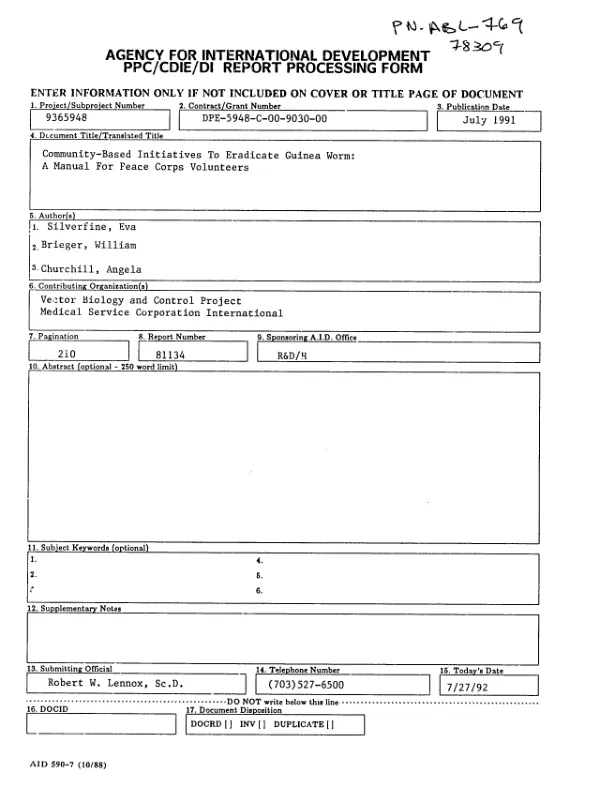
Community-based initiatives to eradicate guinea worm : a manual for Peace Corps volunteers
Sign inMEDICAL SERVICE CORP. INTERNATIONAL
Community-based initiatives to eradicate guinea worm : a manual for Peace Corps volunteers
The purpose of this manual is to show Peace Corps community promoters, health agents, and schoolteachers how to work with communities and government extension agents to eliminate guinea worm disease (GWD).
Silverfine, Eva; Brieger, William +1 more · 1991
Sign in to readA free account is required to download.
Abstract
The disease, also known as dracunculiasis, is a parasitic infection caused by a long stringlike worm, the nematode Dracunculus medinensis. Although people rarely die from GWD, it is extremely painful and incapacitating. It occurs in Africa and Asia, and an estimated 3-5 million people are affected each year. The tragedy is that people do not realize how easy it is to eliminate GWD from their lives. Because it is transmitted only through drinking contaminated water, GWD is the only water-based disease that can be entirely prevented through education and improvement of drinking water supplies. This manual is intended to serve as a reference for volunteers engaged at all levels of the GWD eradication effort. Chapter 1 provides basic background information on the disease -- the Guinea worm life cycle, GWD symptoms, and GWD treatment from both western and traditional perspectives. Chapter 2 discusses the impact of GWD on the individual and the community. Prevention options are presented in Chapter 3, which guides the volunteer in the role of health educator, and in Chapter 4, which provides information on water resource protection. Chapter 5 reviews methods for determining the extent of the GWD problem in the community for both community-level and national-level planning, and Chapter 6 outlines the process by which communities can plan, implement, and evaluate GWD intervention activities. Appendices provide a variety of material on health education, water resource development and disinfection, and community health surveys. (Author abstract, modified)