USAID. MISSION TO LESOTHO
Community natural resource management
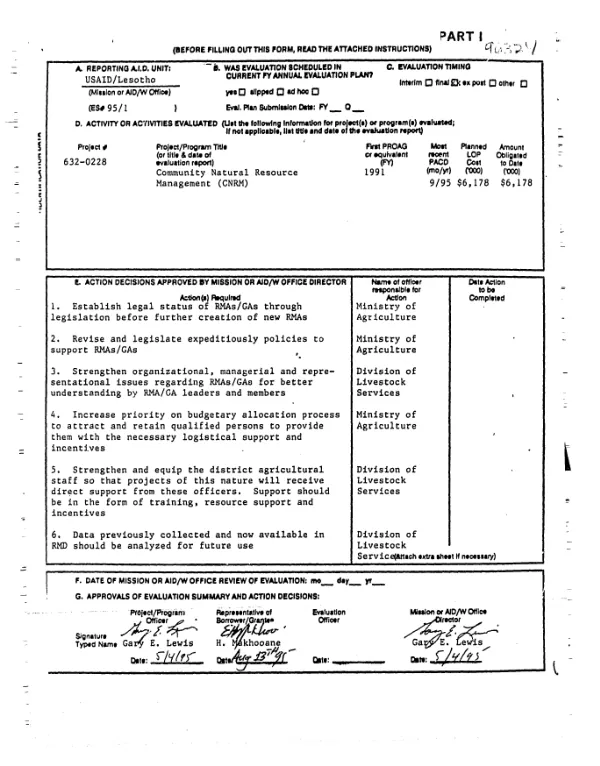
Project to improve range management in Lesotho by expanding the system, developed in projects 6320215 and 6320221, of range management areas (RMA"s) managed by community-based grazing associations (GA"s).
1991
Sign in to readA free account is required to download.
Abstract
The project will provide TA, training, and some construction costs to create six new RMA"s (for a new total of 10) on 180,000 ha of rangeland. A 6-person long-term TA team, at least 3 of them Basotho, will help the Ministry of Agriculture"s (MOA) Range Management Division develop implementation plans for each RMA, and conduct on-the-job training for GA management, executive committee members, and employees. Short-term advisors will help the MOA conduct specialized studies in the areas of policy analysis, impact assessment, natural resource management, training needs, etc., and may organize training seminars or courses for MOA staff. The strategy for developing RMA"s will emphasize strong community commitment, and from the outset GA members will be expected to contribute their share of the cost of establishing and operating the RMA"s. TA teams will also work to expand investment opportunities in rural areas as alternatives to livestock for migrant workers" remittances. Finally, Peace Corps volunteers will assist in community organization and GA formation, nonformal education, business and management skills, and water resource development. The project will fund in-country, regional, and some degree training for individuals ranging from government and GA officials to women farmers and herdboys in GA management, business skills, livestock farming, etc. The National RMA Training Center in Sehlabathebe, scheduled for completion in 1992, will be the site of most short-term training, and will receive funding for the first 3.5 years of operation, after which it is expected to become self-supporting; the center will also be the site of special seminars and workshops for mid- and senior level officials. Some personnel will be sent for regional training at institutions such as the Mananga Agricultural Management Center in Swaziland, in skills such as farm planning, financial management, and data processing. Degree training at regional or overseas institutions will include 2 M.Sc. degrees in range management, 2 B.S. degrees in geographic information systems, and 1 B.S. degree in rural sociology. The project will finance 85-95% of the construction for the new RMA"s -- staff housing, office/storage facilities, livestock handling facilities, fencing, water development, and access roads -- through cost sharing arrangements worked out with each GA, which will provide the balance of inputs, possibly in the form of in-kind contributions.