USAID DEC
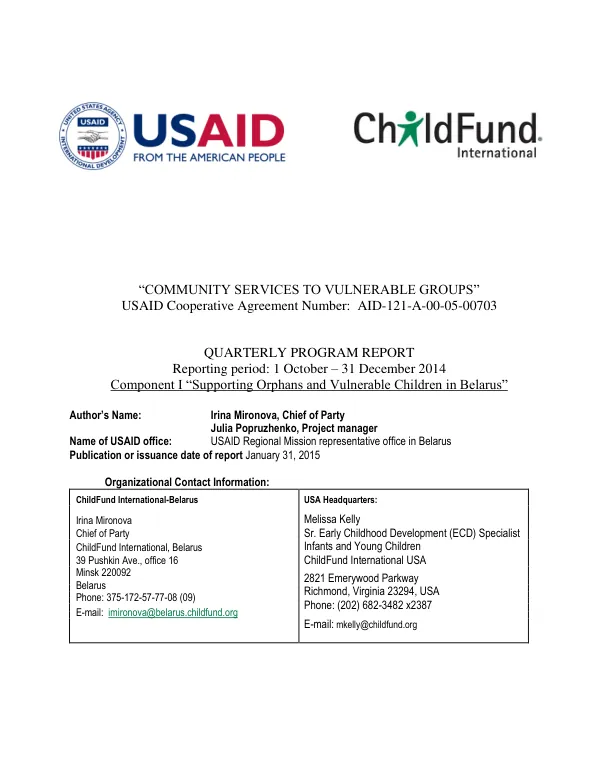
Community Services to Vulnerable Groups: Quarterly Program Report October - December 2014
Sign inCHILD FUND INTERNATIONAL
Community Services to Vulnerable Groups: Quarterly Program Report October - December 2014
The Orphans and Vulnerable Children component in Belarus aims to reduce the number of children in institutionalized care by supporting at-home family care and moving children out of institutions.
2014 · 14 pages
Sign in to readA free account is required to download.
Abstract
The project targets "social orphans," children whose parents are living but unable to provide proper care, or children of parents who have been denied parental rights. The project's activities focus on working with families and social service professionals to maintain and reintegrate children within their original family units. The project has three main objectives: improve access to and further develop an integrated system of community-based prevention and services for families with institutionalized and at-risk children; improve the quality of training and education available to social service providers; and provide technical assistance to social service providers through policy development, methodology consultations, and advocacy efforts. This quarter, the project's activities focused on the sustainability of changes introduced within the course of project implementation, including maintaining strategic partnerships with communities and re-training institutes, expansion of training programs to universities, supporting sustainability of prevention and rehabilitation services, capacity building for specialists, and advocacy. The implementation of community-based services targeting risk factors for child abuse, neglect, and institutionalization continued, supported through community resources, sub-grants, and alumni of ChildFund's training programs. ChildFund specialists provided targeted consultations and interventions to support sustainability of established services such as Parenting Skills Enhancement Program, SafeCare, PRIDE, and the reformation of the child protection system through multidisciplinary cooperation and the development of informal child protection mechanisms. By the end of December 2014, 81 communities from all over Belarus had specialists trained on the Family-centered Approach in child protection services. The TOT alumni provided step-down trainings for 237 community specialists from 143 organizations in 89 localities. The Parenting Skills Enhancement Program was implemented in schools and preschools in 42 geographic locations, with 723 parents attending the program and 32% of these parents being those under the supervision of child protection services or those parenting children with disabilities. The PRIDE training program for foster and adoptive parents was implemented in 37 geographic locations in 47 organizations. Through sub-grants, Chaussy and Grodno communities developed a local implementation model of SafeCare home visitation services that considers availability and specificities of local resources. Three Day Care centers that were piloted within the project proved to be sustainable, with local authorities allocating budgets to continue their functioning. The goal of improving the quality of training and education available for social service providers was achieved through a partnership with the network of re-training institutes and cooperation with universities. A new methodological manual on Social Rehabilitation of Families at Risk was published and started being distributed to child protection authorities and specialists as a comprehensive reference for organizations on rehabilitation processes, case management, and closing, and the effective assessment of the work carried out. The project's main outputs during the period between October 1 and December 31, 2014, include 1,267 parents and 124 children accessing community-based prevention and rehabilitation services, 643 child protection specialists and local authorities participating in capacity building events, and 431 specialists receiving targeted consultations and support. The project faces several challenges, including staff turnover in the child protection system, which leads to significant losses of trainers' resources in the communities. However, despite this challenge, the reformation in community child protection systems continued in 71% of communities due to previously established multidisciplinary teams and quality standards approved by the local oblast authorities. The project also faces changes among leadership of education authorities, which may impact the project, but ChildFund will seek new opportunities that these changes may provide.
Related documents