WORLD HEALTH ORGANIZATION
Comparative Research on International Rehabilitation Policies
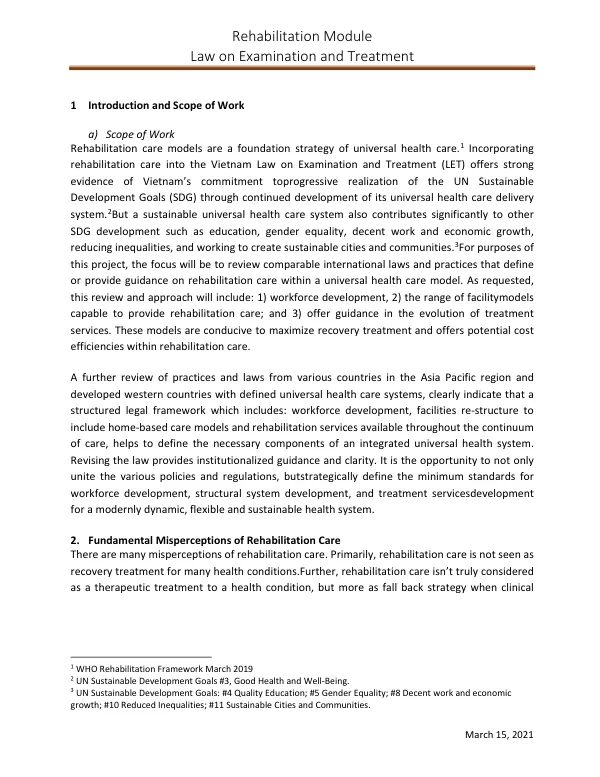
Rehabilitation care models are a foundation strategy of universal health care.
2019 · 15 pages
Sign in to readA free account is required to download.
Abstract
Incorporating rehabilitation care into the Vietnam Law on Examination and Treatment (LET) provides strong evidence of Vietnam's commitment to progressive realization of the United Nations Sustainable Development Goals (SDG). A sustainable universal health care system contributes significantly to other SDG, such as reducing inequalities, decent work and economic growth, and creating sustainable cities and communities. The focus of this report is to review comparable laws and practices that define or provide guidance on rehabilitation care within a universal health care model. This review includes workforce development, the range of facility models capable of providing rehabilitation care, and offering guidance in the evolution of treatment services. These models are conducive to maximizing reabsorption treatment and offer potential cost efficiencies within rehabilitation care. A further review of practices and laws from various countries in the Asia Pacific region and developed countries with universal health systems indicates that a structured legal framework, which includes workforce development, facilities re-structuring to include home-based care models, and rehabilitation services available through the continuum of care, defines the necessary components of an integrated health system. Revising the law provides institutionalized guidance and clarity, uniting the various policies and regulations and strategically defining the minimum standards for workforce development, structural system development, and services development for a modern, flexible, and sustainable health system. There are many misperceptions of rehabilitation care. Primarily, rehabilitation care is not seen as recovery treatment for many health conditions. Rehabilitation care is not considered as a therapeutic treatment to a health condition, but rather as a fall-back strategy when other methods fail. This misperception undermines the very premise of Universal Health Care (UHC). The World Health Organization (WHO) recognizes that rehabilitation care is an integral phase or connective tissue of the health care continuum. The focus of "rehabilitation care" has traditionally been categorized within a field of silos, each with its own separate disability designation. Each disability silo has been based on permanent disabilities such as physical (loss of limb) or sensory (sight or hearing). These silos have worked to misrepresent rehab care as a clinical model in the context of handicap mobility service that concentrates on physiotherapy or orthotic/prosthetic devices such as wheelchairs or replacement limbs. The practice of placing disability in silos has only served to diminish the comprehensive capacity of rehabilitation care as a recovery service to all. Vietnam's rehabilitation system structure is a high-institutionalized and centralized model. There are aspects of a Community-Based Model (CBR) at the commune/health station level; however, it can be classified as a modified institutionalized model, with many actual services and therapies based out of facilities such as Day Centers, Commune Health Stations, District or Province level facilities. Currently, there are 63 rehabilitation hospitals/centers, including 37 rehabilitation hospitals/centers managed by the health sector, 25 rehabilitation hospitals/centers managed by other related sectors. 100% of general hospitals and specialized hospitals at the central level have their own rehabilitation departments. 90% of general hospitals and 40% of specialized hospitals at the provincial level have their own rehabilitation departments/divisions. The healthcare services and delivery models found in modern universal health care systems have restructured to focus more on decentralized delivery models, including supported discharge and home-based care as possible. At the forefront of this re-structure are the benefits of a flexible and well-trained, non-physician workforce, including physician assistants, nurse practitioners, and allied health practitioners (AHPs) and assistants. This health workforce has been key to the development of a sustainable universal health system in developed countries and will be key to UHC development in Vietnam over the next 10 years. Non-communicable diseases (NCDs) are the next wave of health conditions to increase disability and mortality-related conditions. NCDs are credited as the next phase of conditions responsible for the greatest global burden and increase in mortality factors. NCDs include conditions such as neurological injuries, stroke, card events (heart attacks), hypertension (high blood pressure), and diabetes. Rehabilitation care and development will be a vital role in preventing or limiting the disabilities associated with these NCDs. The World Health Organization (WHO) model for rehabilitation care is well understood to be most effective when those services are part of an overall health system strategy. Rehabilitation care is an integral component of any health system that directly affects aspects of society, including the burden of care, reduction in workforce, and economic diminishment of communities, families, and limitations of the affected individual.