USAID DEC
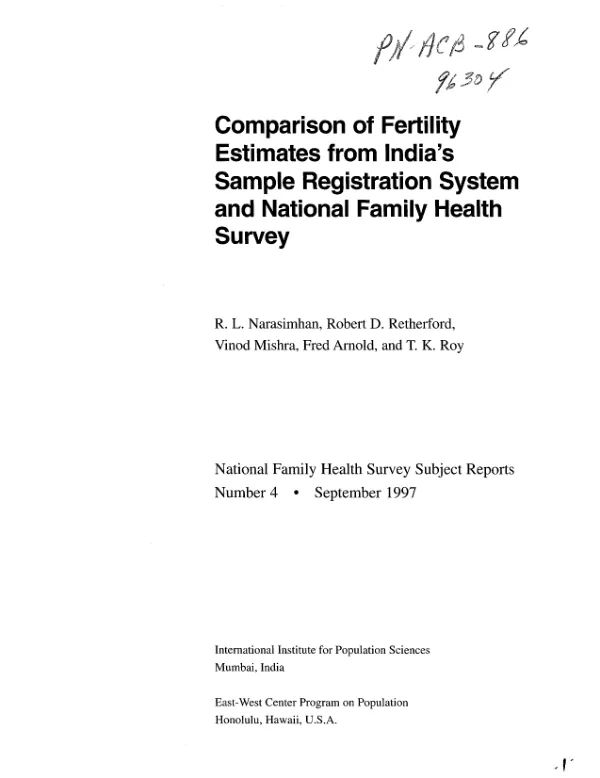
Comparison of fertility estimates from India"s sample registration system and national family health survey
Sign inEAST-WEST CENTER (EWC). PROGRAM ON POPULATION
Comparison of fertility estimates from India"s sample registration system and national family health survey
This report examines the discrepancies between two sets of fertility estimates for the period 1978-92 -- one made by India"s Sample Registration System (SRS), the other by the 1992-93 National Family Health Survey (NFHS).
Narasimhan, R. L.; Retherford, Robert D. · 1997
Sign in to readA free account is required to download.
Abstract
The SRS indicates that fertility level since the late 1970s has fallen faster than does the NFHS. For the period 1988-92, estimates of the general fertility rate made by the two sources coincide, but for earlier years the rate estimated from the NFHS is progressively higher than the rate estimated from the SRS. The analysis suggests three main reasons for this divergence in earlier years: (1) a higher rate of underregistration of births in earlier years in the SRS, (2) backward displacement of births in the NFHS, and (3) omission of births in the NFHS in the first but not the second or third 5-year periods before the survey. Because of the displacement and omission of births in the first 5 years before the survey, the general fertility rate derived from the NFHS for this period appears to be too low. Yet it is identical to the general fertility rate estimated from the SRS for the same period. This suggests that the SRS underregistered births to the same extent that the NFHS displaced and omitted births occurring during this period. In other words, the true level of fertility during 1988-92 was probably somewhat higher than indicated by either the NFHS or the SRS. The NFHS estimate of the general fertility rate for the period 1978-92 is affected little, if at all, by displacement. However, it is affected to some extent by the omission of births during the most recent 5 years of the period and therefore is undoubtedly too low. Despite this omission, the NFHS estimate of the general fertility rate for the 15-year period is 10% higher than the SRS estimate for the same period. This difference implies that the SRS underregistered births during 1978-92 by at least 10%. This level of underregistration is considerably higher than indicated by evaluation studies conducted by the Office of the Registrar General, and it suggests that the improvement in birth registration completeness over time in the SRS has been much greater than previously thought. The curve of fertility by woman"s age tends to be shifted to the right (that is, to older ages) in the SRS, relative to the NFHS. This relative shift appears to be caused mainly by greater misreporting of ages in the SRS than in the NFHS. The analysis was also done for individual states. Discrepancies between the NFHS and the SRS in estimated fertility trends tend to be smaller in states with higher literacy rates than in other states. (Author abstract)
![Child immunization in Madhya Pradesh[, India]](https://covers.devme.ai/gen/19013.webp)