COLORADO STATE UNIVERSITY
Compartmented reservoir; a method of efficient water storage
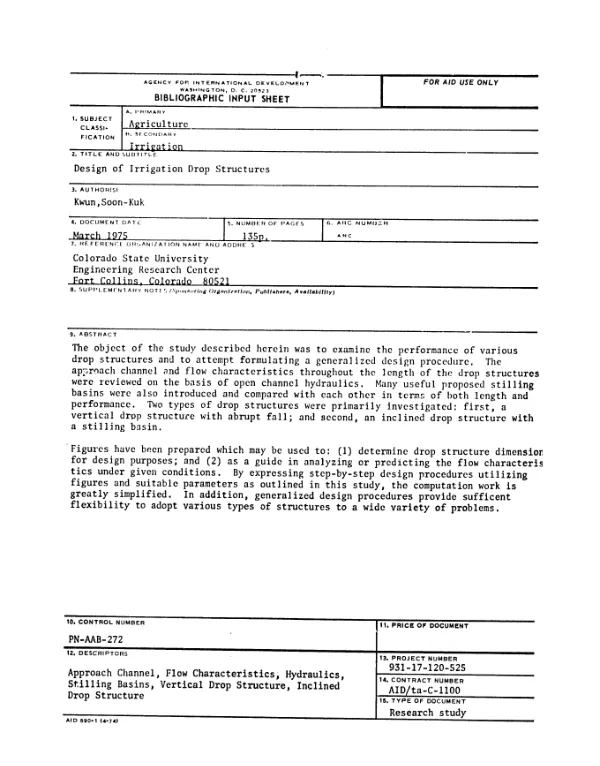
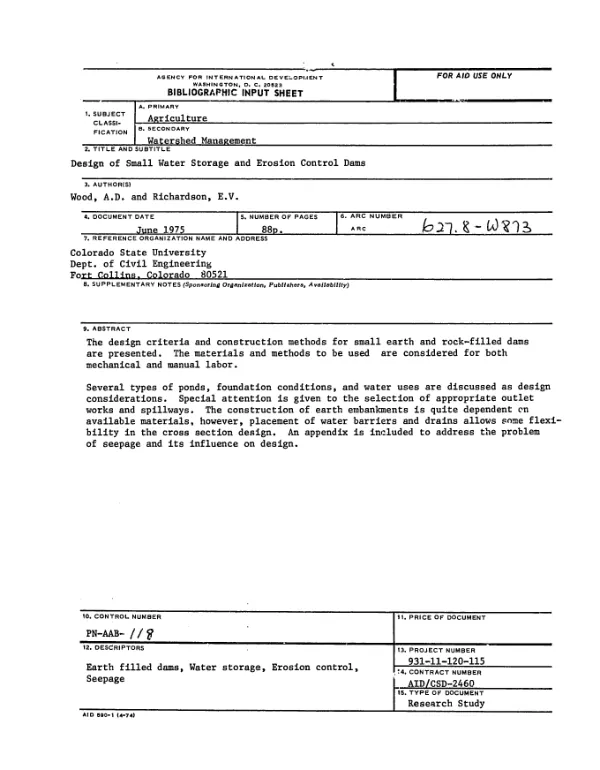
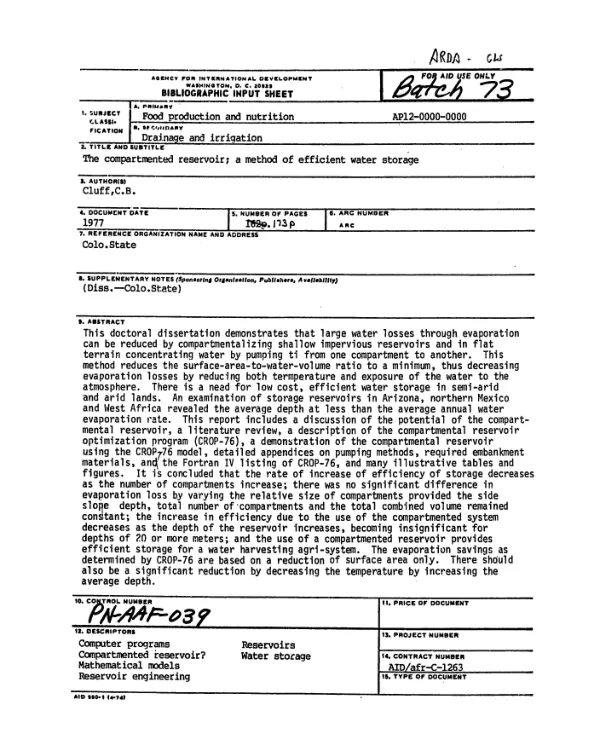
This dissertation demonstrates that large water losses through evaporation can be reduced by compartmentalizing shallow impervious reservoirs and in flat terrain concentrating water by pumping it from one compartment to another.
Cluff, C. B. · 1970
Sign in to readA free account is required to download.
Abstract
This method reduces the surface-area-to-water-volume ratio to a minimum, thus decreasing evaporation losses by reducing both temperature and exposure of the water to the atmosphere. There is a need for low cost, efficient water storage in semi-arid and arid lands. An examination of storage reservoirs in Arizona, northern Mexico and West Africa revealed the average depth at less than the average annual water evaporation rate. This report includes a discussion of the potential of the compartmental reservoir, a literature review, a description of the compartmental reservoir optimization program (CROP-76), a demonstration of the compartmental reservoir using the CROP-76 model, detailed appendices on pumping methods, required embankment materials, and the Fortran IV listing of CROP-76, and many illustrative tables and figures. It is concluded that the rate of increase of efficiency of storage decreases as the number of compartments increase; there was no significant difference in evaporation loss by varying the relative size of compartments provided the side slope depth total number of compartments and the total combined volume remained constant; the increase in efficiency due to the use of the compartmented system decreases as the depth of the reservoir increases, becoming insignificant for depths of 20 or more meters; and the use of a compartmented reservoir provides efficient storage for a water harvesting agri-system. The evaporation savings as determined by CROP-76 are based on a reduction of surface area only. There should also be a significant reduction by decreasing the temperature by increasing the average depth.