USAID DEC
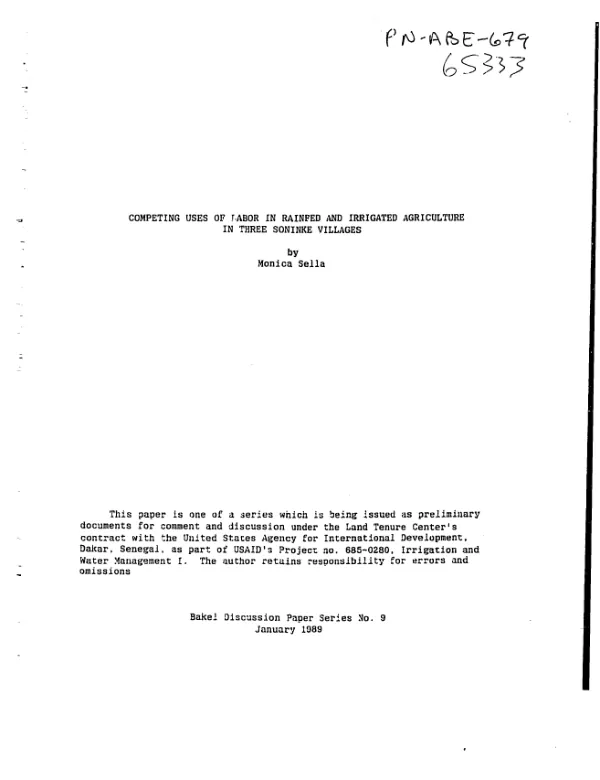
Competing uses of labor in rainfed and irrigated agriculture in three Soninke villages
Sign inUNIVERSITY OF WISCONSIN AT MADISON. LAND TENURE CENTER (LTC)
Competing uses of labor in rainfed and irrigated agriculture in three Soninke villages
Beginning in the middle 1970"s, immediately following the period of severe drought in the Sahel, many African nations undertook heavy investments in river basin development in the hope of creating a more secure, stable, and productive agricultural system.
Sella, Monica · 1989
Sign in to readA free account is required to download.
Abstract
The expectation was that irrigated agriculture, based on a system of double cropping and on the use of modern inputs, would meet both local and national needs by improving rural incomes and generating marketable surpluses. A decade and one- half later this expectation has not been fulfilled, and irrigation remains an activity with more potential than success. This paper considers the experience of one ethnic group: the Soninke of the Department of Bakel. The Bakel Small Irrigated Perimeters (BSIP) project began in 1975 on the initiative of Diabe Sow, a Soninke migrant worker returned from France. The desire to establish a long-term local alternative to migration (given the threat of tightened immigration regulations to the sustained inflow of remittances from France), and to increase local subsistence food production and increase levels of disposable income, led Sow and others to recognize that irrigation with Senegal River water was a promising way to enable the Soninke to supplement their production from rainfed and flood-recession agriculture. In the early stages of the development of the irrigated perimeters, which have been funded since 1977 by USAID, much hope was placed in the new initiative and plans for rapid expansion of irrigated areas were drawn up by Senegalese Government. Today, a decade later, it is evident that the planned expansion did not take place, and indeed, that some farmers -- though they continue to express enthusiasm about irrigation -- seem to give priority to rainfed cultivation rather than to their irrigation activities. (Author abstract)