USAID DEC
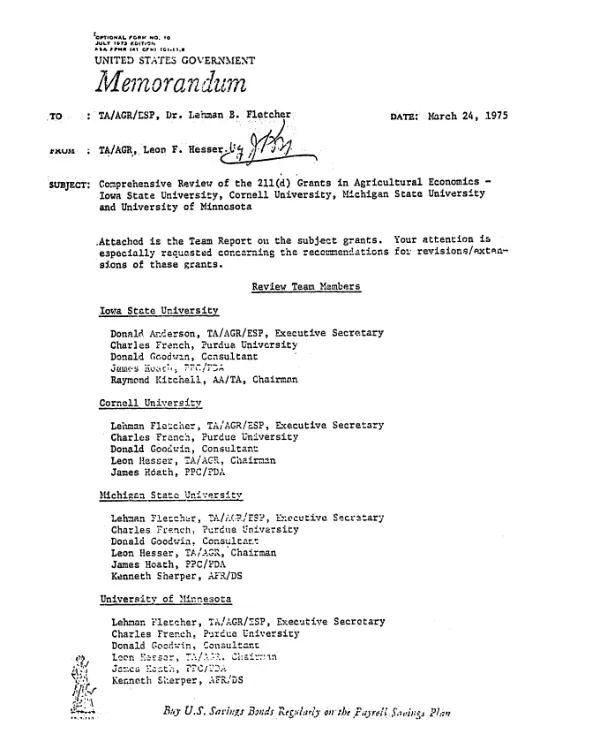
Comprehensive review of the 211(D) grants in agricultural economics : Iowa State University, Cornell University, Michigan State University, University of Minnesota
Sign inUSAID. BUR. FOR TECHNICAL ASSISTANCE. OFC. OF AGRICULTURE
Comprehensive review of the 211(D) grants in agricultural economics : Iowa State University, Cornell University, Michigan State University, University of Minnesota
Evaluates 211D grants to Cornell University, the University of Minnesota (UM), Michigan State University (MSU), and Iowa State University (ISU).
Fletcher, Lehman B.; Anderson, Donald E. · 1975
Sign in to readA free account is required to download.
Abstract
Special evaluation covers the period 5/70-3/75. The impact of 211D support on research, staff development, graduate training, and talent sharing is difficult to quantify. Moreover, grant agreements lacked specific targets for number of staff devoted to LDC-related research, foreign graduate students in agricultural economics, or use of university services by A.I.D. and LDC"s. While all 4 schools now have more faculty involved in agriculture and rural development, their use of 211D funds has varied. Some have stressed participation of faculty from nonagricultural fields and others use of graduate students. The flexibility of the 211D mechanism has allowed support of research not germane to A.I.D."s primary interests. Ironically, while increasing the schools" capacities to perform significant research and to develop informational and personnel resources, the grants have also in most cases increased administrative and academic demands on faculty, thus limiting time spent on research and availability to A.I.D. Specifically: (1) The grant to ISU has increased the size of core staff for development economics. Funds were used primarily to support graduate research. The 211D supplement to a sector analysis in Thailand was an important use of ISU"s 211D-trained faculty and graduate students. (2) Cornell also used 211D mostly to support graduate training. Faculty of the Department of Agricultural Economics have had only limited involvement, and that department, while strengthened, has not reached the point where it can provide A.I.D. with contractual assistance. (3) MSU has expanded its work in sector analysis, marketing, and rural employment generation in Africa, and in international trade and multiple cropping. A significant new sector analysis methodology has been developed. Most funds have been used for graduate research. (4) UM has used 211D to partially fund research and training for at least 20 staff from the Departments of Economics and Agriculture and Applied Economics.
Related documents