USAID. BUR. FOR TECHNICAL ASSISTANCE. OFC. OF EDUCATION AND HUMAN RESOURCES
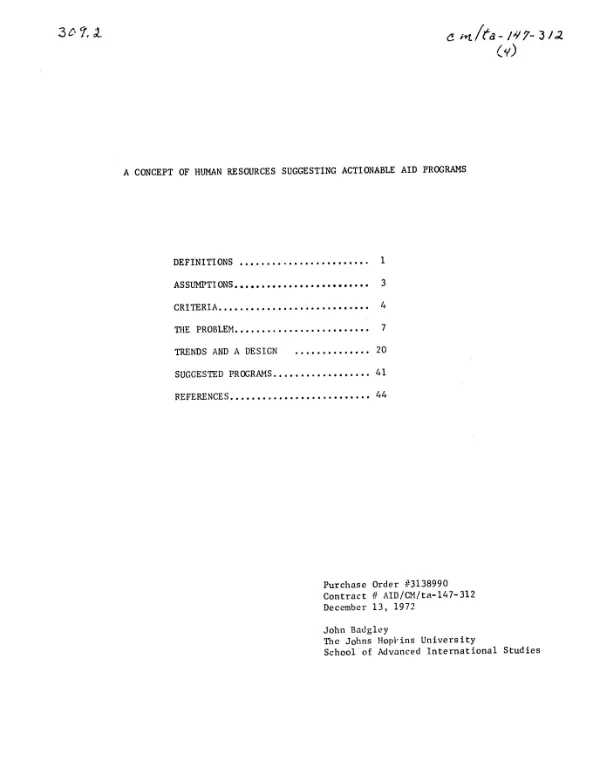
Concept of human resources suggesting actionable aid programs
The purpose of this paper is to explore past assumptions by scholars and program officials in the field of human resources, and to propose an approach offering practical benefit to a majority population in countries receiving AID support.
Badgley, J. H. · 1970
Sign in to readA free account is required to download.
Abstract
Comprehensive planning based in spatial and demographic considerations with focus on new urban centers offering "complete" services is recommended. Family planning, nutrition, health, education, and other welfare programs should be integrated within each region to improve the outreach of centrally dominated development. Decentralization is emphasized to hasten velocity of programs and to build within traditional community institutions when feasible. Involvement of local leaders in decisions about budget and emphasis of programs is a prescriptive measure recommended to enhance their identification with change. The paper weighs the idiosyncratic quality of each culture heavily, and proposes inclusion of expert social scientists (country specialists) within AID programs to serve as bridges with indigenous experts involved in planning. Sensitivity to communal values is of such importance that the author believes most projects will create greater problems than they resolve without weighing this factor scientifically at the outset and throughout the development of each project.
Connected topics