USAID. BUR. FOR PROGRAM AND POLICY COORDINATION. CENTER FOR DEVELOPMENT INFORMATION AND EVALUATION (CDIE)
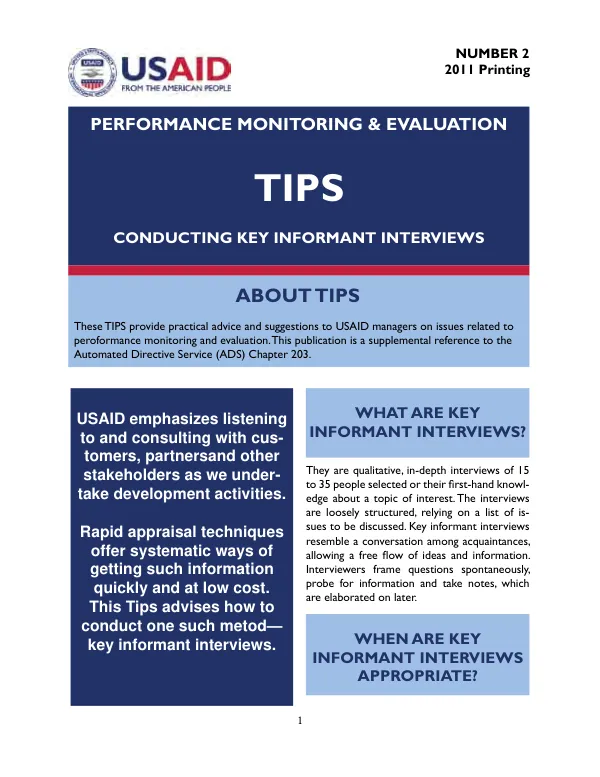
Conducting key informant interviews in developing countries
Although key informant interviews are widely conducted in development settings, the quality and nature of the information they generate is often of dubious value and low credibility.
Kumar, Krishna · 1989
Sign in to readA free account is required to download.
Abstract
To improve the quality of this data collection method, this report provides guidelines for conducting informant interviews in developing countries. After a brief introduction, Section 2 describes the main steps that investigators should take to prepare for the interviews. These include: formulating study questions, reviewing available information, developing a conceptual framework, preparing an interview guide, and selecting key informants. Section 3 details the actual interview process, focusing on meeting and probing informants, wording and sequencing questions, controlling conversations, using translators, and recording the interview. Section 4 profiles simple, practical techniques that can be used to analyze interview data, including summary sheets, descriptive codes, storage and retrieval systems, and presentation of data. Finally, Section 5 describes the steps to take to ensure reliability and validity of the findings by checking the key informant"s "representativeness" and reliability, examining the interviewer"s own possible bias, and keeping an eye out for negative evidence. Overall, the key informant interview is a good evaluation method since it provides information and insight that cannot be obtained with other methods, provides flexibility to explore new issues, and is inexpensive to conduct. However, certain drawbacks exist as well. Key informant interviews do not provide quantitative data, are susceptible to interviewer biases, and can be unreliable if fewer than 15 persons are interviewed.