USAID DEC
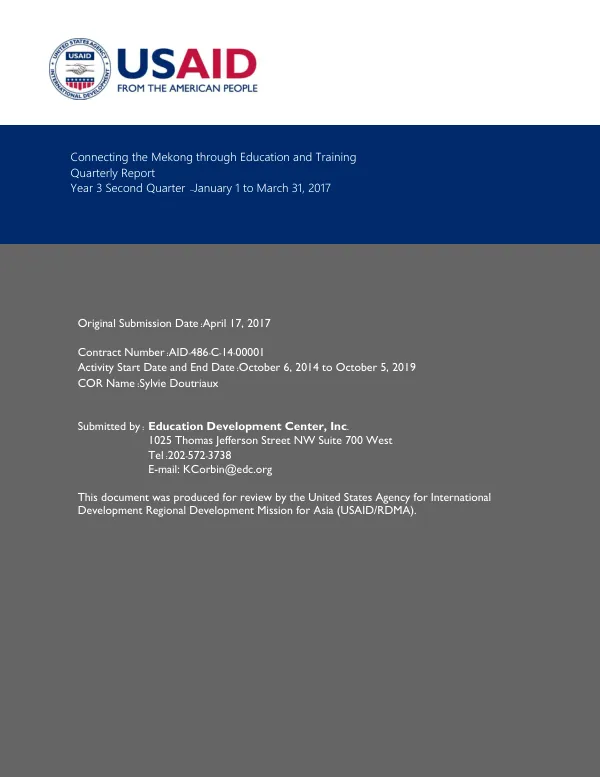
Connecting the Mekong through Education and Training Quarterly Report Year 3 Second Quarter – January 1 to March 31, 2017
Sign inCENTER FOR EDUCATIONAL DEVELOPMENT
Connecting the Mekong through Education and Training Quarterly Report Year 3 Second Quarter – January 1 to March 31, 2017
The Connecting the Mekong through Education and Training (COMET) project is a USAID-funded initiative aimed at strengthening the technical and vocational education and training (TVET) system in the Lower Mekong region.
2017 · 38 pages
Sign in to readA free account is required to download.
Abstract
The project's primary objective is to enhance the employability of youth and adults in the region by improving the quality and relevance of TVET programs. The project is implemented by the Education Development Center, Inc. (EDC) and is expected to run from October 6, 2014, to October 5, 2019. The project's scope encompasses four main components: Curriculum Development and Skilled Workforce, Training Today's Workforce (Vocational), Developing Tomorrow's Leaders (Higher Education), and Industry Partnerships. One of the key initiatives under the project is the MekongSkills2Work (MS2W) portal, which serves as a platform for sharing knowledge, resources, and best practices in TVET. The portal has been improved to increase interactivity, with the launch of the first professional development online course, "Becoming a Certified MekongSkills2Work Network Professional Development Provider." This course is designed to certify MS2W professional development providers and has been completed by MLC instructors. The project has also been working on developing partnerships with the policy community, multinational companies, and local partners. Discussions with the policy community have focused on connections between Thailand's National Science Technology and Innovation Policy Office's work-integrated learning model and the MS2W model for TVET development. The project has also been piloting the Work-based Learning (WBL) toolkit, which has been tested at several institutions in Thailand, Cambodia, and Vietnam. In addition, the project has been extending Phase 1 of the Mekong Learning Centers (MLCs) professional development program from one year to 1.6 years, ending in June 2017. During this extension period, MLCs are receiving additional training using an online modular course through Edmodo, and instructors who complete the course and conduct workshops will become certified MS2W Professional Development Providers. The project has also been working on developing a badging/certification system with Edmodo to formally recognize the achievements of MLC instructors. Badges will be issued through Edmodo and mark instructors' progress towards becoming a certified MekongSkills2Work Professional Development Provider. The project's progress has been influenced by a shift in U.S. Government funding priorities, which has resulted in a reduction in funding for the current fiscal year. As a result, the project has made programmatic cuts to meet the lower anticipated funding level. Despite this challenge, the project continues to make progress in its efforts to strengthen the TVET system in the Lower Mekong region. The project's quarterly report highlights several key achievements, including the launch of the first professional development online course, the extension of Phase 1 of the MLCs professional development program, and the piloting of the WBL toolkit. The report also provides an update on the project's partnerships and highlights several upcoming events and activities. Overall, the COMET project is making significant progress in its efforts to improve the quality and relevance of TVET programs in the Lower Mekong region. The project's focus on institutionalization, partnerships, and work-based learning is expected to have a positive impact on the employability of youth and adults in the region.
Related documents