USAID DEC
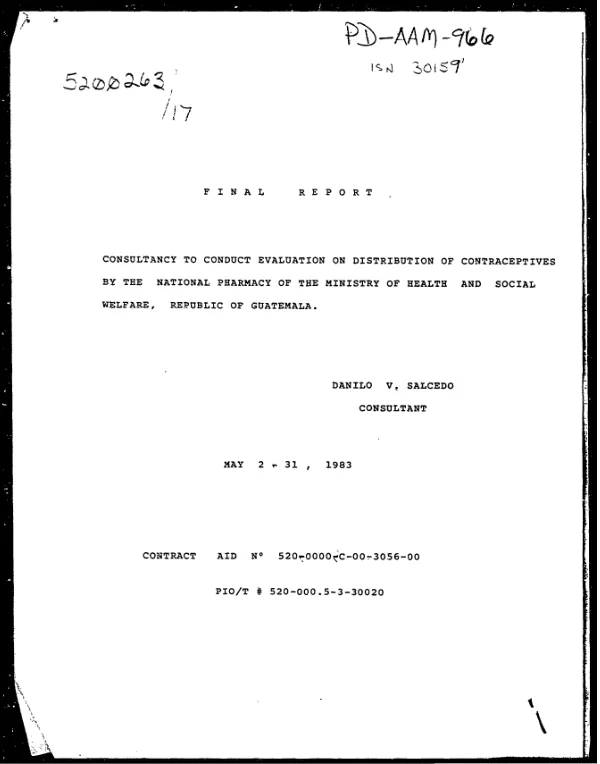
Consultancy to conduct evaluation on distribution of contraceptives by the National Pharmacy of the Ministry of Health and Social Welfare, Republic of Guatemala : final report
Sign inUSAID DEC
Consultancy to conduct evaluation on distribution of contraceptives by the National Pharmacy of the Ministry of Health and Social Welfare, Republic of Guatemala : final report
Evaluates contraceptive distribution by the Guatemalan Ministry of Public Health and Social Welfare (MSPAS) through its National Pharmacy (NP) as part of an integrated family planning (FP) project.
Salcedo, Danilo V. · 1983
Sign in to readA free account is required to download.
Abstract
Special evaluation covers the period 4/80-5/83 and is based on document review, interviews with A.I.D. and host country personnel, and site visits. The FP program lacks a clear organizational structure. MSPAS is being reorganized, and responsibility for project management and international TA has been transferred to a new department; the latter, however, has not established a separate FP unit. Revelatory of this situation, interviews with doctors in charge of the MSPAS health districts showed that many do not view FP as a public health program nor as something promoted by MSPAS and some of those recently appointed have only vague ideas about contraceptive goals for 1984. Minimal use of health promoters to distribute contraceptives and the lack of remumeration to midwives for promoting FP are further negative factors. The number of active contraceptive users served by MSPAS has decreased since 1978. This seems due to a deterioration in MSPAS services; a lack of promotion at the community level, of contraceptives of all kinds (especially of DIU and T-Copper-Coils), and of supervision at all levels; distrust of the NP's cost-free contraceptives; and an increase in voluntary female sterilizations. The NP's own distribution of contraceptives to 11 designated health areas has been deficient due to insufficient stocks at the NP itself, the fact that supplies have been distributed according to a numerical criterion instead of real need and demand, and the NP's lack information on the latter. The recent introduction of contraceptive request forms has not eliminated notable discrepancies, largely because of a lack of understanding of the forms. More positively, direct distribution of contraceptives by the Asociacion Pro-bienestar de la Familia (APROFAM) to health centers and posts in 11 health areas is efficiently run. Distribution rose during 1981-82 but fell to 1978 levels in 1983; actual dissemination to users was not determined by the evaluation. Development of a consolidated FP program is the chief among the 15 recommendations made.
Related documents