USAID DEC
CONTRACEPTING, BREASTFEEDING AND BIRTHSPACING IN MALAYSIA : A MODEL OF DECISION MAKING SUBJECT TO ECONOMIC AND BIOLOGICAL CONSTRAINTS
Sign inRAND CORP.
CONTRACEPTING, BREASTFEEDING AND BIRTHSPACING IN MALAYSIA : A MODEL OF DECISION MAKING SUBJECT TO ECONOMIC AND BIOLOGICAL CONSTRAINTS
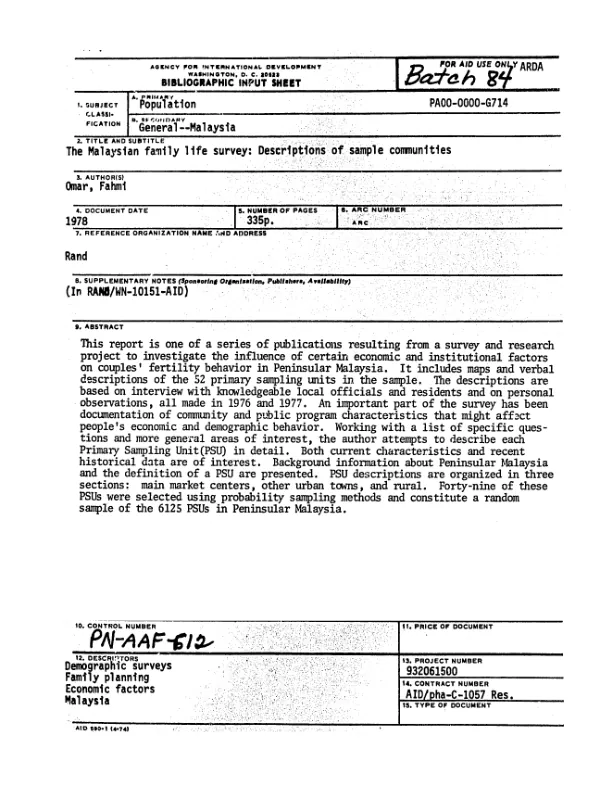
This working note results from a survey and research project to investigate the influence of certain economic and institutional factors on couples" fertility behavior in Peninsular Malaysia.
BUTZ, WILLIAM P.; DAVANZO, JULIE · 1970
Sign in to readA free account is required to download.
Abstract
The purpose of the project was to identify factors within the range of direct public policy influence which directly or indirectly affect birthspacing and family size and to estimate the magnitude of statistical relationships between these factors and the outcomes of interest. Breastfeeding currently provides about one-third more protection against pregnancy than do family planning program contraceptives. This protection is rapidly diminishing in Malaysia and in most other LDC"s due to the decline in breastfeeding. This paper reports empirical evidence concerning these issues. The initial results are from a survey and research project designed to estimate the responsiveness of couples" contraceptive use, breastfeeding, and birthspacing to changes in specific factors under policy influence. The survey was conducted in 52 primary sampling units throughout the country, with a sample of over 1200 households. The characteristics of the sample are described and trends in the demographic variables or principal interests since World War II are discussed. Section III summarizes a model of couples" breastfeeding, contraceptive use, and birthspacing that characterizes behavior in these areas as the result of an optimization process subject to biological and behaviorial constraints. This model is the structure for the regression analyses that follow in Section IV. Separate regression analyses are discussed for length of post-partum amenorrhea, length of full and partial breast-feeding, length of closed menstruating interval, use of contraceptives, length of closed birth interval, infant mortality, and birthweight. The last section reviews the findings and discusses some implications for public policies, particularly those that influence the supplies of contraceptives, infant food, and health care.
Related documents