POPULATION REFERENCE BUREAU, INC. (PRB)
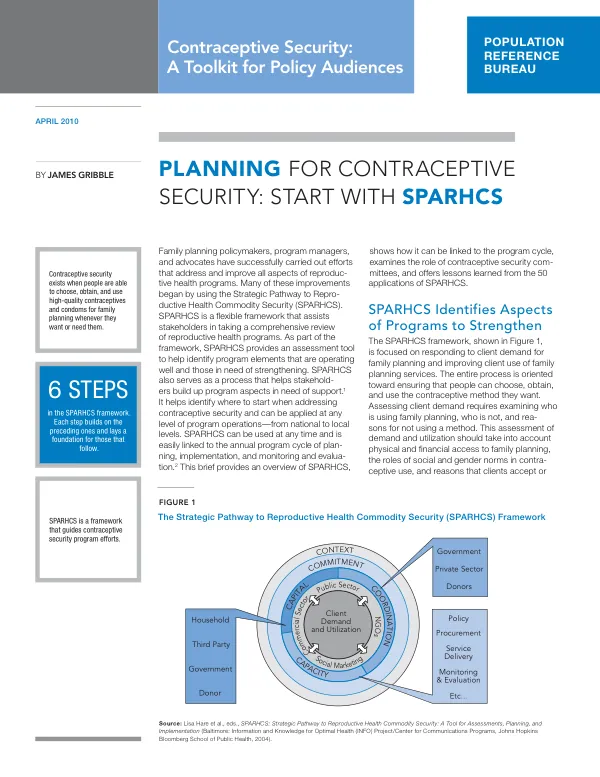
Contraceptive security for policy audiences : an overview
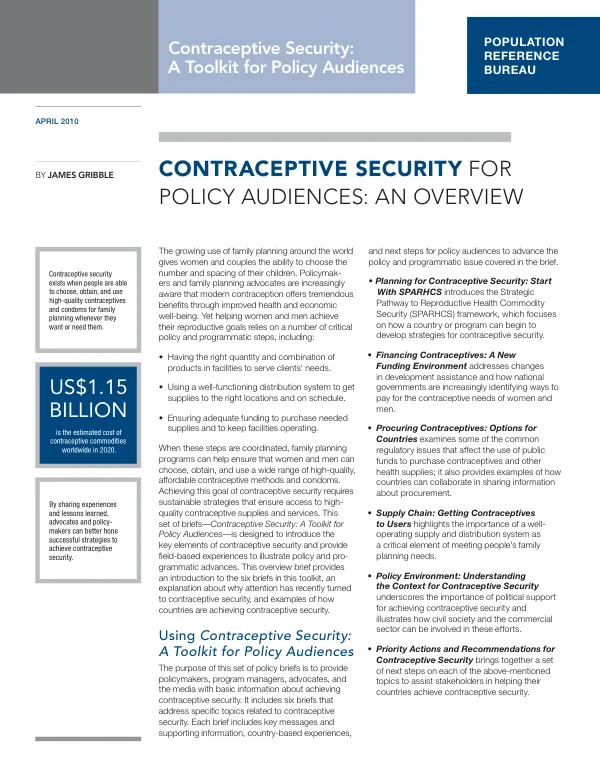
The growing use of family planning around the world gives women and couples the ability to choose the number and spacing of their children.
Gribble, James · 2010
Sign in to readA free account is required to download.
Abstract
Policymakers and family planning advocates are increasingly aware that modern contraception offers tremendous benefits through improved health and economic well-being. Yet helping women and men achieve their reproductive goals relies on a number of critical policy and programmatic steps, including: Having the right quantity and combination of products in facilities to serve clients" needs; Using a well-functioning distribution system to get supplies to the right locations and on schedule; Ensuring adequate funding to purchase needed supplies and to keep facilities operating. When these steps are coordinated, family planning programs can help ensure that women and men can choose, obtain, and use a wide range of high-quality, affordable contraceptive methods and condoms. Achieving this goal of contraceptive security requires sustainable strategies that ensure access to high-quality contraceptive supplies and services. This set of briefs--Contraceptive Security: A Toolkit for Policy Audiences--is designed to introduce the key elements of contraceptive security and provide field-based experiences to illustrate policy and programmatic advances. This overview brief provides an introduction to the six briefs in this toolkit, an explanation about why attention has recently turned to contraceptive security, and examples of how countries are achieving contraceptive security. (Excerpt)