USAID DEC
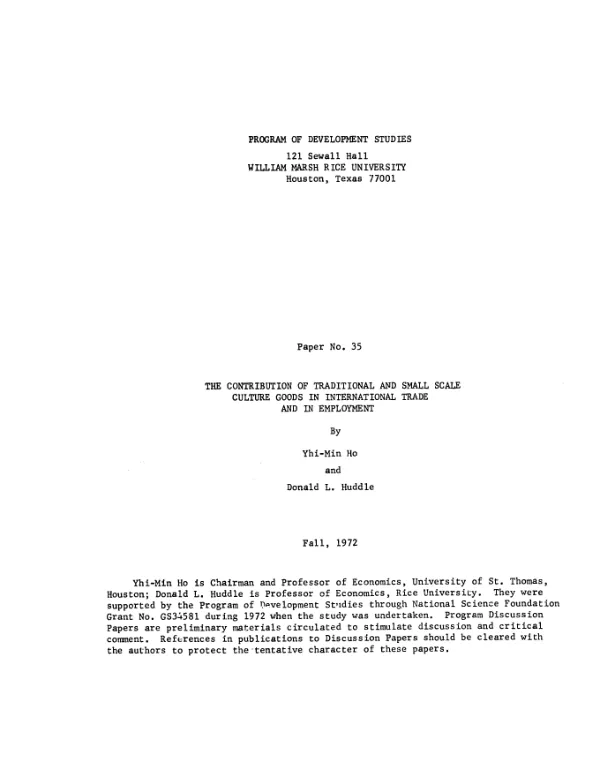
Contribution of traditional and small scale culture goods in international trade and in employment
Sign inRICE UNIVERSITY
Contribution of traditional and small scale culture goods in international trade and in employment
The present paper reports an analysis of 81 commodities participating in international trade.
Ho, Yhi M.; Huddle, D. L. · 1970
Sign in to readA free account is required to download.
Abstract
The 81 commodities represent a highly disaggregated sample of traditional artisan and small scale products in which LDC"s would a priori seem to have a special advantage in exporting according to the factor proportions theorem. Though it has been cogently argued elsewhere that traditional and handicraft products will tend to disappear as development proceeds, there are other reasons to adduce that such products might play an increasing, not a decreasing role in international trade. Eighty-one commodities were examined cross-section and in time series. The analysis showed that small scale traditional products and goods of cultural and artistic distinction have increasingly participated in international trade, being produced largely by developing countries and exported to U.S. and OECD markets. With only several exceptions these commodities consistently had income elasticities of import demand exceeding unity, with the weighted total being well over 2. Since domestic production less exports and similar broad categories were growing more rapidly than per capita income, though more slowly than imports, we can conclude that income elasticities of demand for U.S. consumption of these categories were even higher than our data show.