DAI GLOBAL, LLC
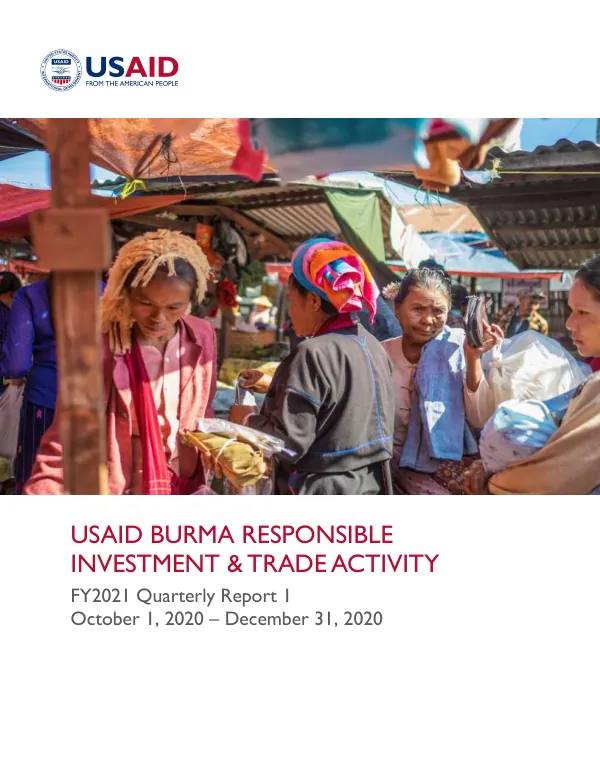
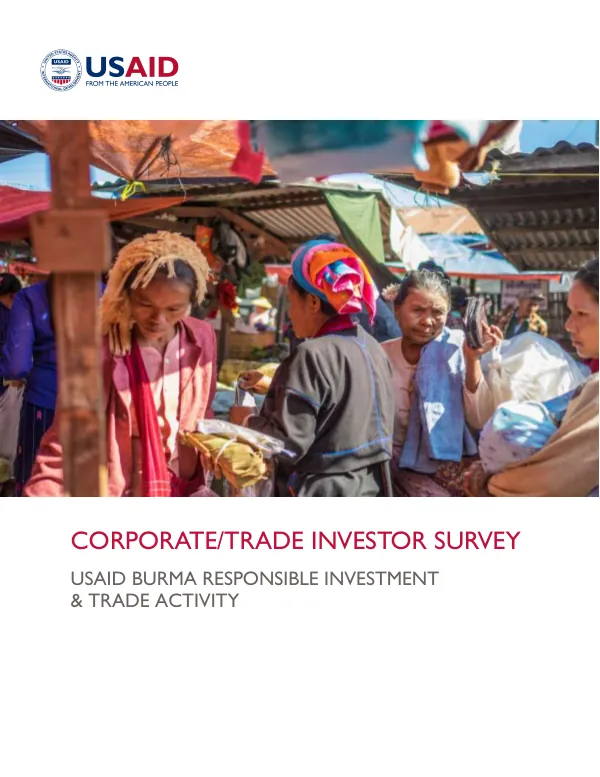
Corporate/Trade Investor Survey
The USAID Burma Responsible Investment and Trade Activity is a five-year program launched in 2020 with a budget of USD 18.7 million.
2021 · 21 pages
Sign in to readA free account is required to download.
Abstract
The program aims to increase responsible trade and private sector investment in Myanmar by improving corporate governance, business transparency, and competitiveness. The program is being implemented by DAI Global, LLC and is designed to work with international and domestic private sector firms and civil society actors to promote civilian ownership of the Myanmar economy. The program's approach to strengthening the private sector is guided by four objectives: increasing fair and responsible trade and investment in Myanmar, improving corporate governance and business transparency, promoting economic integration and investment, and empowering women to participate in the economy. To achieve these objectives, the program will identify and support transactions that bring new investments into Myanmar, increase gender-lens investing, de-risk investments in non-urban areas, build business capacity, increase private sector compliance with regulations, and strengthen corporate accountability. The program's methodology involves conducting extensive desk research on investment in Myanmar, identifying top countries with the highest levels of foreign direct investment, and interviewing foreign commercial representatives and business associations to identify corporate/trade investors. The program also conducted a corporate/trade investor survey from November 6 to December 21, 2020, to understand the motivations and challenges faced by corporate/trade investors in Myanmar. The survey findings identified a variety of challenges and roadblocks faced by corporate/trade investors, including difficulty in finding suitable local partners, negative perception of Myanmar's investment landscape, underdeveloped financial sector, complex tax rates and regulations, illicit trade, underdeveloped infrastructure, inefficient government bureaucracy, weak legal and regulatory framework, skill shortages and skill gaps in the labor market, and legal uncertainty and political risk. Based on the survey findings, the program has made recommendations to support corporate/trade investors and Myanmar's private sector. These recommendations include supporting media and communications, facilitating corporate/trade investment, and improving access to finance. The program aims to overcome the challenges and roadblocks faced by corporate/trade investors and contribute to the growth of the private sector in Myanmar. The program's geographic focus is on Myanmar, and its timeframes are from July 2020 to June 2025. The program's recommendations are designed to inform the program's strategic planning and implementation and contribute to the growth of the private sector in Myanmar. The program's approach is guided by USAID's Private Sector Engagement Strategy, Indo-Pacific Strategy, and the Integrated Country Strategy. The program's implementation details include identifying and supporting transactions that bring new investments into Myanmar, increasing gender-lens investing, de-risking investments in non-urban areas, building business capacity, increasing private sector compliance with regulations, and strengthening corporate accountability. The program's geographic focus is on Myanmar, and its timeframes are from July 2020 to June 2025. The program's geographic focus is on Myanmar, and its timeframes are from July 2020 to June 2025. The program's recommendations are designed to inform the program's strategic planning and implementation and contribute to the growth of the private sector in Myanmar.
Related documents