USAID DEC
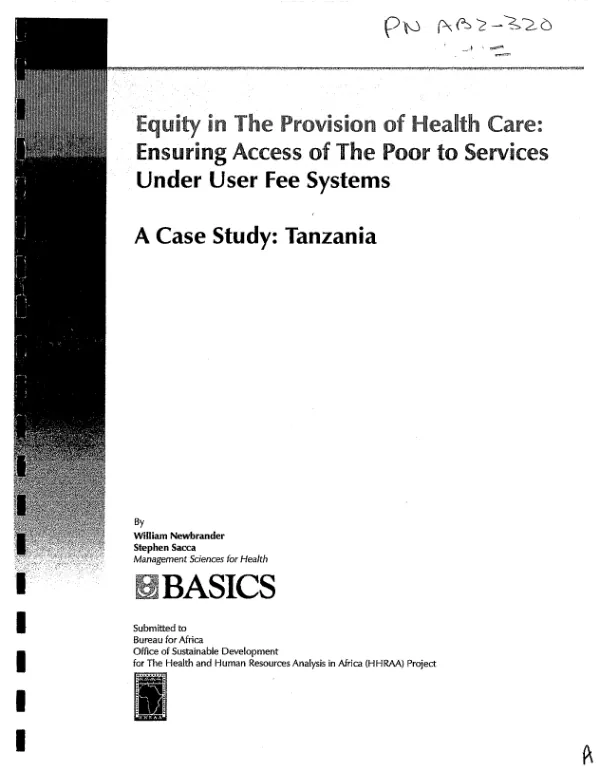
Cost sharing and access to health care for the poor : equity experiences in Tanzania
Sign inMANAGEMENT SCIENCES FOR HEALTH (MSH)
Cost sharing and access to health care for the poor : equity experiences in Tanzania
Tanzania"s Ministry of Health has introduced two mechanisms to ensure equitable access to services under its new cost-recovery system: waivers of user fees for those unable to pay, and exemptions from payment, regardless of ability to pay, for certain types of patients (i.e., children under five, the elderly, and women for maternal child health services) and for patients with certain illnesses (i.e., tuberculosis, leprosy, polio, AIDS, cancer, diabetes).
Newbrander, William; Sacca, Stephen · 1996
Sign in to readA free account is required to download.
Abstract
The Government has also sought protection by restricting fees to hospital care and by setting fees at very low levels. This study examines the effectiveness of these measures. Key findings are as follows. (1) Concerned with generating revenues, hospital administrators have granted very few waivers. At least some of the poor, however, are benefitting under the Government"s exemption program. (2) Following a long tradition, NGO hospitals in Tanzania ask patients to contribute whatever they can afford at the time of treatment. Yet all patients are treated alike regardless of ability to pay, thanks in part to clear articulation by senior NGO management of the underlying philosophy of the hospitals. (3) There are very few operational guidelines and training for hospital staff in the use of waivers and exemptions. Further, little public information has been disseminated about the waivers and exemptions. Some facilities do not want to advertise waivers and exemptions because of concerns of abuse. However, in an attempt to minimize leakage (non-poor receiving waivers to which they are not entitled), there may be undercoverage of the deserving poor because the guidelines on waivers are applied too stringently. Several facilities have initiated their own efforts within the community and have had some success. (4) The current system for reporting the number of waivers is not functioning, making it difficult for the Ministry to evaluate the waiver and exemption system on an ongoing basis. The effectiveness and cost of the system cannot be known without such information. (5) Many facilities are in such dire financial straits that the revenues generated by cost sharing are being used as working capital and as emergency funds for recurrent costs, such as petrol for vehicles. If the cost-sharing program is to be successful and acceptable to the public, the revenues must be used to improve quality and services in a way the public can see, such as improved drug supply, new sheets for wards, and repaired diagnostic equipment. Recommendations address these problems.
Related documents