RESEARCH TRIANGLE INSTITUTE (RTI)
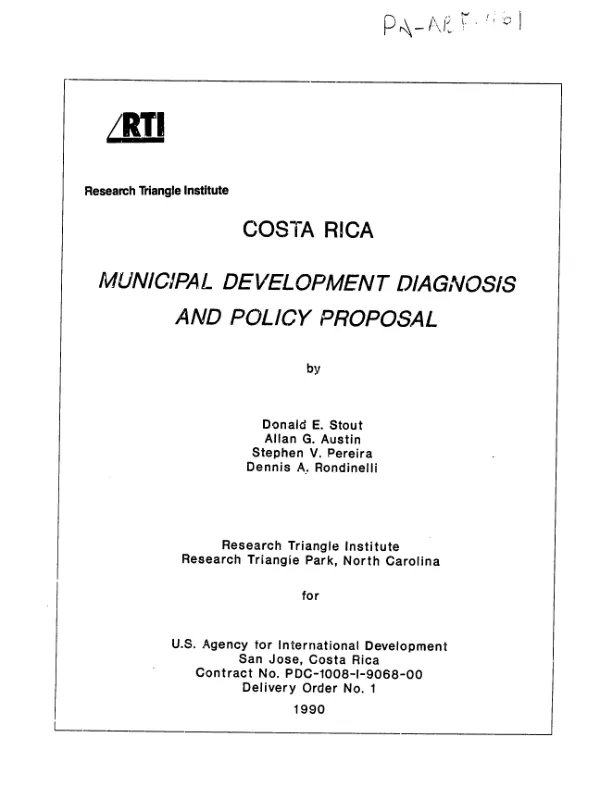
Costa Rica : municipal development diagnosis and policy proposal
In Costa Rica, central government institutions have nearly complete control of local public sector goods and services.
Stout, Donald E.; Austin, Allen G. · 1970
Sign in to readA free account is required to download.
Abstract
Control is exercised through laws, authority over revenue and funding sources, and fiscal controls and auditing powers. This dominance of the central government is draining the nation"s economy, with almost all budget revenues being absorbed by recurrent expenditures. As a result, support is growing for decentralizing resources and responsibilities to municipalities and the more productive private sector. This report analyzes the kinds of decentralization that could be carried out without constitutional or legislative changes, relying solely on administrative actions by the executive branch. Four such methods are described: deconcentration, delegation, devolution, and privatization/deregulation. The report emphasizes that, given Costa Rica"s long history with centralized government, successful decentralization strategies must respond to social, as well as technical constraints and provide a sufficiently long time frame to accommodate incremental change. Recommendations for A.I.D. highlight the importance of involving, but also restructuring the role of, the Instituto de Fomento y Asesoria Municipal, the premiere municipal advisory agency in Latin America. Appendices include case histories of decentralization experience in Colombia and Indonesia.
Related documents
Documents in this collection
 1992
1992USAID DEC
Decentralized provision of public services and governance and management of renewable natural resources : the Senegal case
Open record 1997
1997USAID DEC