USAID DEC
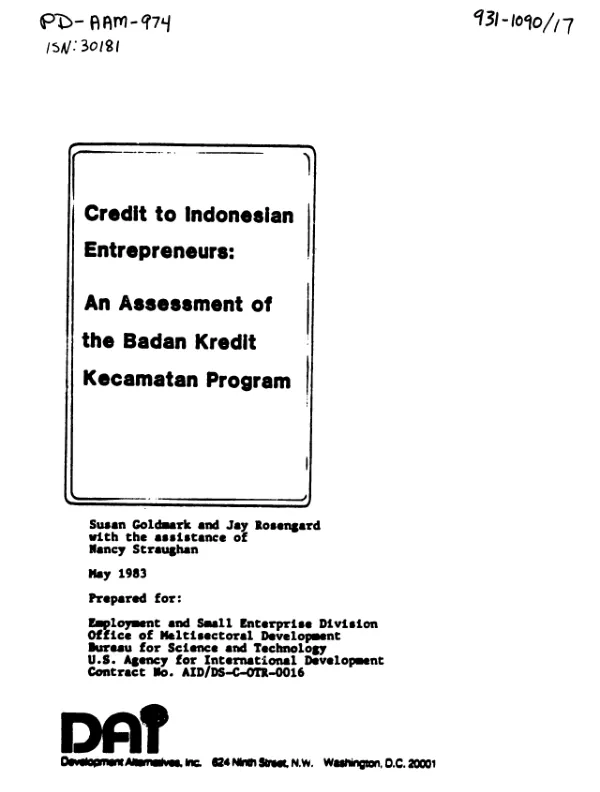
Credit to Indonesian entrepreneurs : an assessment of the Badan Kredit Kecamatan Program
Sign inDEVELOPMENT ALTERNATIVES, INC. (DAI)
Credit to Indonesian entrepreneurs : an assessment of the Badan Kredit Kecamatan Program
Studies the impact of the program of the Badan Kredit Kecamatan (BKK), supported by A.I.D.'s Provincial Area Development Project in Indonesia.
Goldmark, Susan G.|Rosengard, Jay|Straughan, Nancy · 1983
Sign in to readA free account is required to download.
Abstract
The program, which operates at the village level in 486 of Central Java's 492 subdistricts under supervision of the Regional Development Planning Body and the provincial government, is designed to supply low-cost credit to the rural poor for income-generating activities. A random survey of 662 representative BKK clients at 20 BKK units showed that BKK loans have promoted the expansion of most borrowers' businesses and have helped about a fourth of BKK clients begin new activities. Loans were used mostly as working capital. High loan repayment rates indicate that most borrowers are using the loans well. The loans have also helped reduce unemployment moderately. The program has contributed significantly to village and area development. Local impact has primarily been through suppliers of BKK clients, most of whom are petty traders and handicraft workers, and through BKK clients' increased purchasing power. The program is far from fully servicing the province's demand for rural off-farm credit, however, and forward linkages have not been significant, nor have BKK clients passed their cost-savings on to consumers. The program has its greatest community impact in areas where it is used for district-wide development. Although the BKK program is financially and administratively self-sustaining, A.I.D. technical assistance should be continued to improve program administration, develop a small industry loan window, and improve the voluntary savings program. Other problems to be addressed are the revival of those BKK units - 33% of the total - which are barely functioning or have closed; the addition of new village posts; diversification and expansion of the BKK loan portfolio; and the attraction and retention of high caliber personnel. The program's success depends on its blend of political support and accountability, decentralized operations, skilled supervision, convenience and low cost to clients, a socially cohesive setting, and a moderately expanding economy. The absence of any one of these factors could doom efforts to replicate the program elsewhere.
Related documents