CENTER FOR INTERNATIONAL DEVELOPMENT AND ENVIRONMENT (WORLD RESOURCES INSTITUTE (WRI))
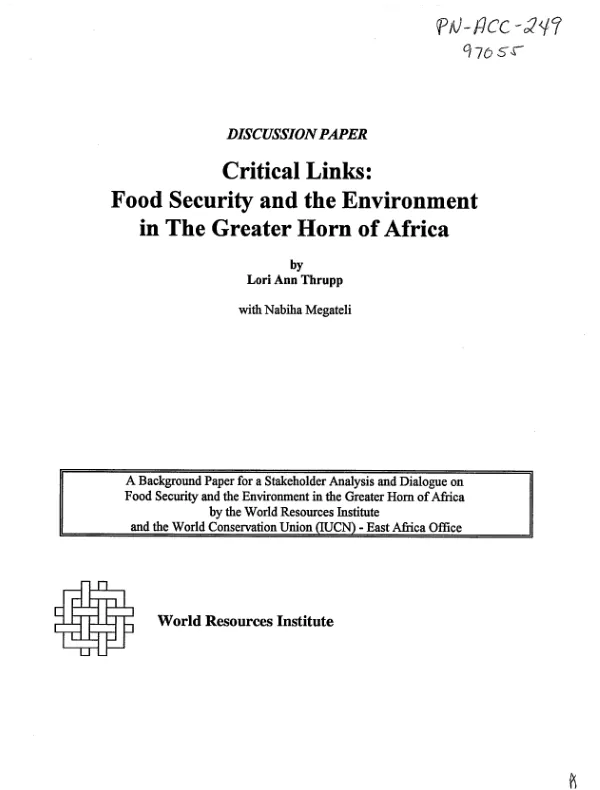
Critical links : food security and the environment in the Greater Horn of Africa
Drawing upon a wide range of studies and knowledge in the field, this paper provides a synthesis of major challenges and opportunities in the food security- environmental nexus in the Greater Horn of Africa (GHA).
Thrupp, Lori Ann; Megateli, Nabiha · 1998
Sign in to readA free account is required to download.
Abstract
The analysis concludes with the key strategic principles that are needed to reverse the downward spiral of hunger, resource degradation, poverty, and conflict: (1) promote regional cooperation among stakeholders; (2) focus on critical transboundary issues and resources; (3) confront the roots of interlinked food and environmental problems; (4) promote participation and empowerment in food/environmental security initiatives; (5) enhance diversity of economic, ecological, and social conditions; (6) mobilize and strengthen initiatives and resources for food/environmental security; and (7) uphold and build upon international conventions on food security and biological diversity. Key areas for regional action include (1) policy reforms; (2) sustainable agriculture that embraces diversity and agroecological principles; (3) institutional and government changes and capacity building; (4) distributional reforms and equitable opportunities; (5) regional conflict resolution and governance reforms; (6) demographic change through education and health services; and (7) research and information challenges. Special attention should be given to vulnerable groups, such as refugees, women, children, and displaced pastoralists, and to risk-prone regions, which are subject to more serious impacts and suffering. (Author abstract, modified)