USAID. BUR. FOR SCIENCE AND TECHNOLOGY. OFC. OF AGRICULTURE
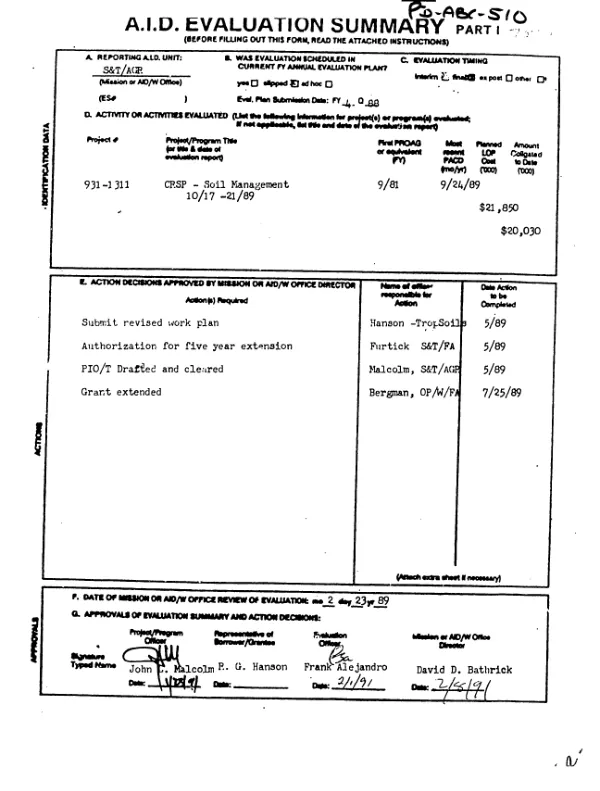
CRSP - soil management, 10/17-21/89
Summarizes final evaluation (XD-ABC-510-A) of a project to promote collaborative research to improve the management of tropical soils.
1991
Sign in to readA free account is required to download.
Abstract
External evaluation covers the period 1981-88. The project is being implemented through subgrants to four universities -- North Carolina State University (NCSU), Cornell, Texas A&M, and the University of Hawaii. These universities have conducted research at prime sites in Peru, Indonesia, Brazil, and Niger representing three agro-ecological zones: humid tropics, the acid savannas, and semi-arid tropics. Achievements to date include: (1) sustained grain production for 16 years in the upper Amazon (NCSU); (2) drought resistant, nitrogen fixing cover crops which provided enough nitrogen for a corn crop (Cornell); (3) trash mulching in the Guesselbodi forest in Niger to encourage forest regeneration, and doubled millet and sorghum yields through water harvesting (Texas A&M); (4) development of the fertility capability classification system to improve fertilizer recommendations in tropical regions (NCSU); and (5) development of the ACID4 expert system for liming (University of Hawaii). The project has also funded 2 B.Sc."s, 25 M.Sc."s, 51 Ph.D"s, and 6 postdoctoral fellowships. Overall, the project is one of the few global programs with an achievement record in areas of marginal lands and fragile environments of the high and low rainfall tropics, and could form the nucleus of a worldwide R&D effort in these areas. principal problem has been the reduction in funding from $3 million to $2.1 million. The costs of maintaining U.S. university personnel abroad are high and the number of expatriates in the host countries will have to be reduced unless more funds are forthcoming. Several lessons were learned. (1) It is difficult to carry out activities as planned when funding is reduced and no allowance is made for inflation; in this case, the transfer of the knowledge and technology benefits of this project to programs around the world would require a major sacrifice in the research effort. (2) The transfer process can be sped up by inviting USAID Agricultural Development Officers from non-host countries to visit host-country research sites. (3) Although the collaborative research mode removes much of the administrative burden from A.I.D. officers, the technical project officer should interact more with program scientists. Subsequent to the evaluation, the project was extended for 5 years. Although additional support was obtained, this did not restore funding to the previously authorized level.