USAID. BUR. FOR SCIENCE AND TECHNOLOGY. OFC. OF RURAL AND INSTITUTIONAL DEVELOPMENT
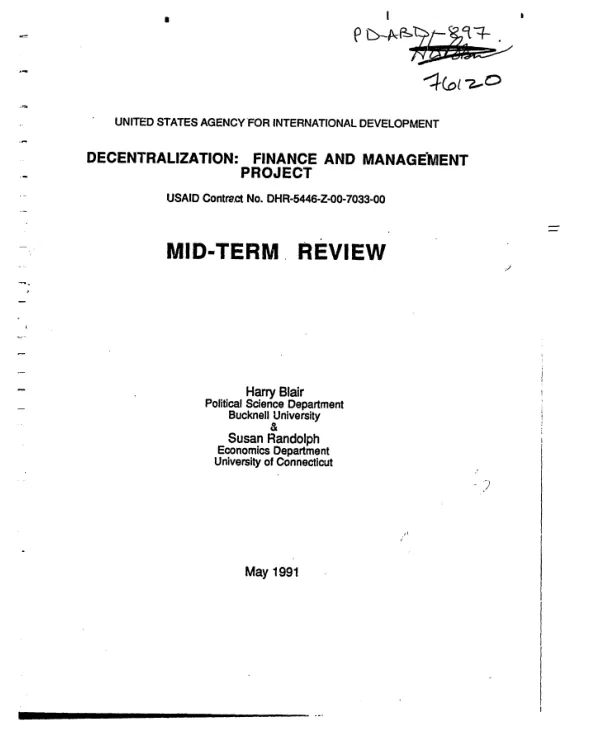
Decentralization : finance and management project -- mid-term review
Midterm evaluation of a project to use institutional analysis as a guiding approach to the financing and management of rural infrastructure.
Blair, Harry|Randolph, Susan · 1991
Sign in to readA free account is required to download.
Abstract
The evaluation covers the period 9/87-5/91. The project has been generally successful. Starting from a focus on rural infrastructure, it has now expanded sectorally to include natural resource management and structural reform. Significant short-term TA has been provided to seven Missions (Nepal, Indonesia, Bangladesh, Cameroon, the Philippines, Zaire, and Mali) in the areas of roads, irrigation, forestry, local resource mobilization, decentralization, and parastatal marketing reform. The TA in most cases has been regarded as well done, professionally sound, and highly useful. However, long-term "demonstration country" TA has not been provided as planned, mainly because Missions have been reluctant to provide buy-in funding, although it now appears that two of the three anticipated long-term buy-ins are likely to be implemented. The absence of long-term applied TA has meant that the project has not been able to test its approach under prolonged field conditions. To a certain extent, the project has been able to compensate for this by drawing on the experience of senior staff and taking advantage of other research, not funded by A.I.D. As a result, the project is on or even ahead of schedule in producing general analytical material, including a state-of-the- art paper (currently under review by a major academic publisher), three sector papers, and a theoretical article. Information has been disseminated through two newsletters, seminars, lectures, and presentations to a variety of audiences. The challenge of combining theoretical analysis and project-oriented TA in a single project has on the whole been met successfully. The project has had some success in interesting other development thinkers and practitioners in using its institutional analysis approach. However, most Missions and host country development professionals have seen the project as a useful source of project-specific expertise, rather than as a general method for understanding development issues and formulating policy. It is recommended that the project be extended 2 years.