USAID DEC
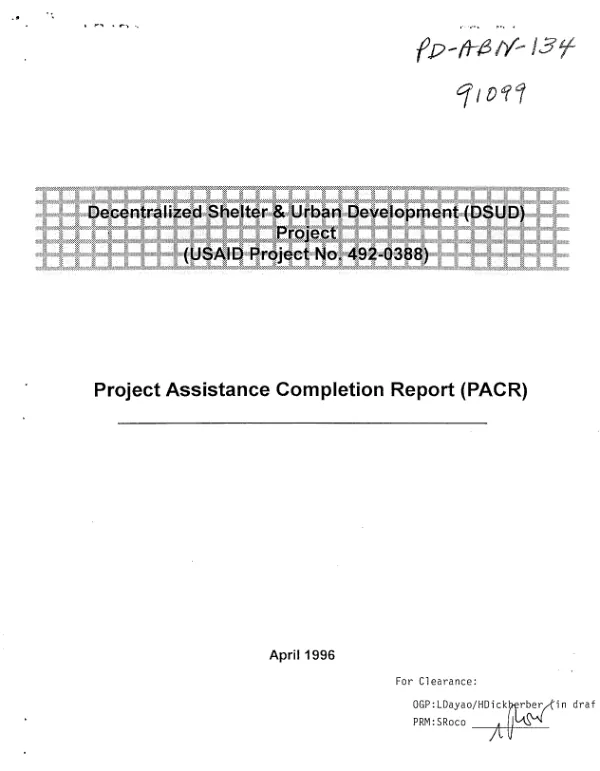
Decentralized shelter and urban development (DSUD) project (USAID project no. 492-0388) : project assistance completion report
Sign inUSAID. MISSION TO PHILIPPINES
Decentralized shelter and urban development (DSUD) project (USAID project no. 492-0388) : project assistance completion report
PACR of a Housing Guaranty (HG)/TA project (1990-96) to foster a greater role for elected city governments, the private sector, and NGOs in the development of shelter-related infrastructure in chartered cities in the Philippines.
1996
Sign in to readA free account is required to download.
Abstract
Project objectives were fully achieved. The Government of the Philippines (GOP) complied fully with all policy requirements, in some cases exceeding targeted accomplishments. Key areas of concern included: (1) developing self-sustaining financing systems for chartered cities; (2) reducing urban and environmental infrastructure constraints on local economic development; and (3) improving access to sustainable urban shelter delivery systems for low-income households. Owing to a large dollar reserve, the GOP decided to forego the last $15 million of the $50 million authorized HG loan. Unfortunately, the GOP was unable to continue its Community Mortgage Program (CMP), aimed at helping communities acquire financing for land and urban services. Although the project had successfully piloted the CMP, demonstrated its cost-effectiveness, and trained 50 NGOs to promote community participation in the program, the inability of the National Home Mortgage Finance Corporation to process loans resulted in fewer than 50 CMP loans. Many of the communities found alternate financing, however. TA was provided mainly by Planning and Development Collaborative International (PADCO). This included monitoring of the GOP's policy achievements, and direct TA to 11 cities and to the League of Cities in capital investment planning, shelter planning, credit finance, and land use mapping and management. Both Cebu and Naga now have a working Geographic Information System (GIS), and Naga has completed a feasibility study for a new integrated bus terminal and commercial center, including all activities to float a local bond. TA to the League of Cities resulted in 13 sharing programs which featured best practices in the areas of solid waste, sewerage, road, shelter infrastructure, and urban environmental services; this program enabled officials from all 60 chartered cities to see practices that actually work and to learn to copy or adopt them. The last City Sharing Program enabled the cities to firm up their action plan for making Philippine cities livable. The plan was submitted to the national government for inclusion in the upcoming Habitat II Conference. Similarly, an Urban Sector Review and a draft Urban Policy Framework resulting from project TA helped to focus the GOP's attention on urban management, particularly environmental issues. The following lessons were learned. (1) The project provided a good model for how a policy-based sectoral HG program can be made to work. It demonstrated that long-term involvement in an integrated program with clearly focused policy sub-objectives can lead to important, measurable policy change while avoiding the dangers of project fragmentation. (2) Where local democracy exists along with an appropriate framework for decentralization with accountability, USAID assistance is likely to be more productive if it directly supports and facilitates local initiatives.