ABT ASSOCIATES, INC.
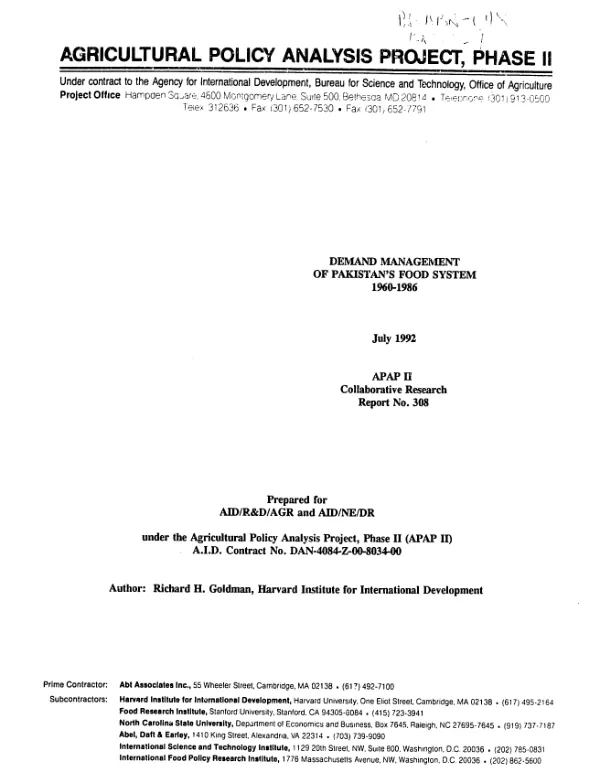
Demand management of Pakistan"s food system -- 1960-1986
During the quarter century 1960-1986 Pakistan"s food system was dramatically transformed.
Goldman, Richard H. · 1992
Sign in to readA free account is required to download.
Abstract
Over that period, per capita calorie consumption improved dramatically, the share of cereal calories provided by domestic production increased, and diets became more diverse. This process was partially promoted by a rapidly growing agricultural sector and important growth and diversification of per capita incomes. Policy makers, in the context of this demand expansion, faced conflicting policy objectives. On the one hand there was a need to promote additional food consumption from the low level that prevailed in the 1960s. On the other hand, additional domestic food production could be urged to substitute for imports or expand exports, thus generating scarce foreign exchange and contributing to food self-sufficiency goals, particularly for wheat. The management of food demand, through trade and other pricing policy instruments, resulted in dramatically changing patterns of prices and consumption in the food system. This paper traces the evolution of Pakistan"s food system through three distinctly different periods: the Green Revolution thrust toward wheat self-sufficiency and food consumption growth; the economic stagnation of 1970-76 with rapidly rising food prices and the search for new sources of food supplies; and the post 1976 economic recovery and diet diversification. The paper places special emphasis on complex interactions within the food system associated with the diet diversification process, particularly the rapid increase in edible oil and milk consumption and the recent trend toward declining per capita consumption of wheat. (Author abstract)