USAID. BUR. FOR POLICY AND PROGRAM COORDINATION. CENTER FOR DEVELOPMENT INFORMATION AND EVALUATION (CDIE)
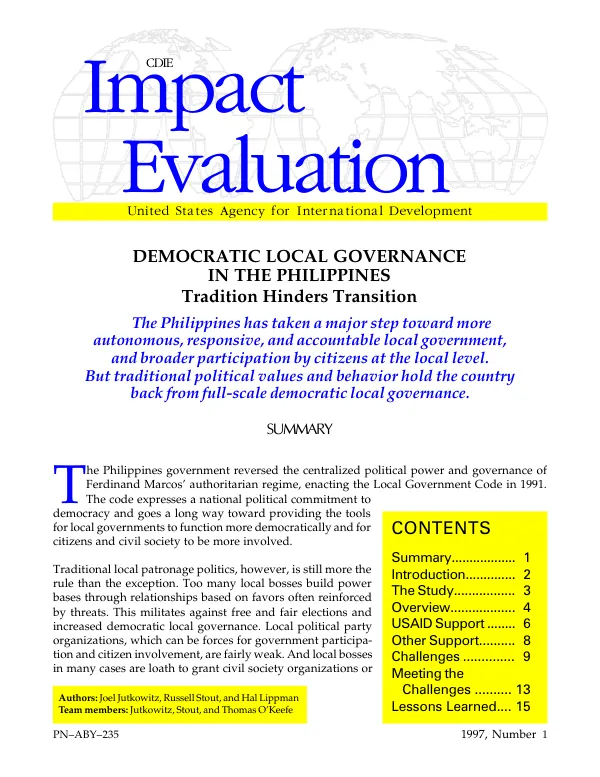
Democratic local governance in the Philippines : tradition hinders transition
Although the Philippines has made major progress toward more autonomous and accountable local government by enacting the Local Government Code in 1991, traditional political values and behavior still hold the country back from full-scale democratic local governance.
Jutkowitz, Joel|Stout, Russell|Lippman, Hal · 1996
Sign in to readA free account is required to download.
Abstract
Too many local bosses build power bases through relationships based on favors (often reinforced by threats). Local political party organizations are fairly weak, and local bosses in many cases are loath to grant civil society organizations or citizens the roles carved out for them in the Local Government Code. Thus concludes this evaluation, which reviews USAID's long history of support for democratization in the Philippines. In the 1970s, for instance, the Agency sponsored a trip to the United States for mayors and other local officials (including the principal author of the Local Government Code) to receive training in public administration. Over the past 15 years, USAID has given more than $78 million to NGOs and people's organizations to support their role as agents of democratic change and reform. Since 1992, the Agency has supported civil society directly, with $15.1 million to help fisherfolk, urban poor, and indigenous peoples form coalitions. Through the Local Development Assistance Project (1990-95), USAID provided $50 million to help decentralize government functions; increase local governments' authority, and resources; and broaden citizen participation. In 1995, the Agency began the Governance and Local Democracy project, to which USAID has already committed $20 million to support development through decentralized governance. These programs have had a visible impact on the progress of democratic local governance in the Philippines. However, the country still faces the formidable barriers of patronage-style politics, electoral fraud, exclusion of civil society, weak local party organizations, and citizens' lack of knowledge about democratic rights and responsibilities. Lessons learned from USAID's experience with democratic local governance in the Philippines include the following. (1) It is important to build an understanding of democratic processes and develop tools for implementing democracy, even if it means having to wait for the right time to pursue related reforms. (2) Political will is essential at both the national and local levels. (3) Civil society organizations can fill the void when local political parties aren't strong enough to ensure citizen participation and government accountability. (4) Donors need to be flexible and anticipate changing circumstances. (5) Promoting democratic principles and attitudes is essential, but is often ignored in the traditional emphasis on improving local government administration and service delivery. (Author abstract, modified)
Related documents
Documents in this collection
 1970
1970USAID DEC
Democratic local governance in the Philippines : tradition hinders transition
Open record 1996
1996USAID DEC