USAID DEC
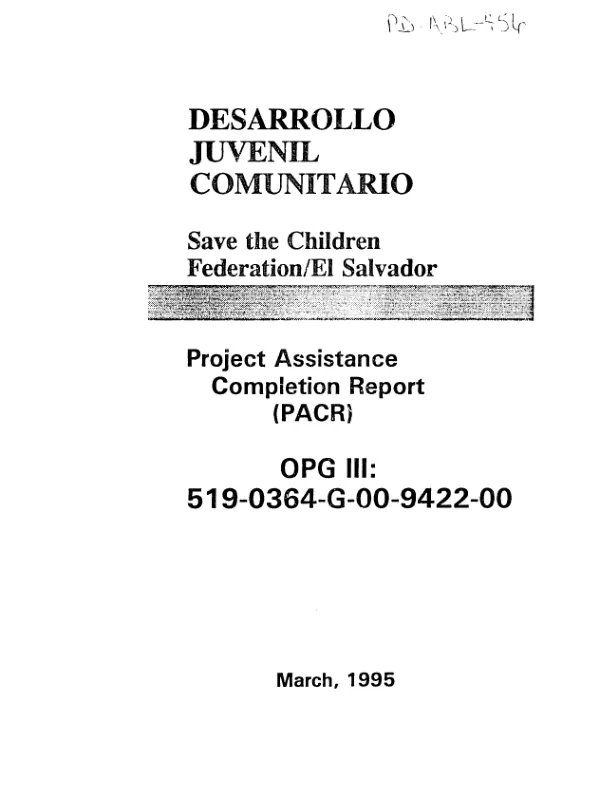
Desarrollo Juvenil Comunitario -- Save the Children Federation/El Salvador : project assistance completion report (PACR) -- OPG III, 519-0364-G-00-9422-00
Sign inUSAID. MISSION TO EL SALVADOR
Desarrollo Juvenil Comunitario -- Save the Children Federation/El Salvador : project assistance completion report (PACR) -- OPG III, 519-0364-G-00-9422-00
PACR of an OPG (5/89-12/94) to Save the Children Federation (SCF) and its Salvadoran affiliate Desarrollo Juvenil Comunitario (DCJ) to continue and expand its community-based integrated rural development (CBIRD) program in two new impact areas of La Union.
1995
Sign in to readA free account is required to download.
Abstract
Thanks in part to a sharper focus as recommended by the mid-term evaluation, the project proved quite successful, with TA and field activities reaching a total of 139 communities in 2 new and 4 follow-up impact areas with 15 types of subprojects in the program areas of health, education, sustainable agriculture, and potable water. About 2,841 of a targeted 3,000 small farmers increased production and real income through TA in basic grain production, animal husbandry, soil conservation, and crop diversification. A comprehensive primary health program reached 4,361 children (vs. a targeted 1,500) with interventions in oral rehydration therapy (ORT), family planning, breastfeeding, growth monitoring and vaccination, and environmental sanitation; key reasons for the success of this component were the efforts of the Center for Nutrition Education and Early Childhood Stimulation (CENET) and project training for traditional midwives. About 4,520 vs. a targeted 3,440 additional children were given access to kindergarten and primary school in 142 schools in 83 communities, and 203 teachers were trained. Community development committees were formed in 104 rural communities; 39 of the committees have obtained legal status and developed long-term plans to continue working for their communities, and another 22 are in process of legalization. The development of a self-confident and responsible attitude in these communities was perhaps the most lasting impact of SCF's work with them. Other accomplishments included financial support for the El Carpintero-El Sauce potable water project, the first phase of which was completed in 5/94 and which will ultimately serve 15,000-20,000 people, and development of a system to monitor program impact on the basis of defined indicators. Five case histories of project interventions are included in the report. Lessons learned include the following. (1) Focus should be placed on doing a few things very well, rather than attempting a number of objectives which become difficult to monitor and evaluate. (2) Impact indicators should be limited in number, easily understood, and perceived to be useful by the community. (3) Cooperation with other institutions helps to increase resources brought into communities (the potable water project being a case in point) and increases the likelihood of project sustainability, as does focusing on the process of community organization and leadership development rather than on physical projects. (4) Highly technical projects will require specialized technical expertise: apply the maxim "do it right the first time!"
Related documents
Documents in this collection
USAID DEC
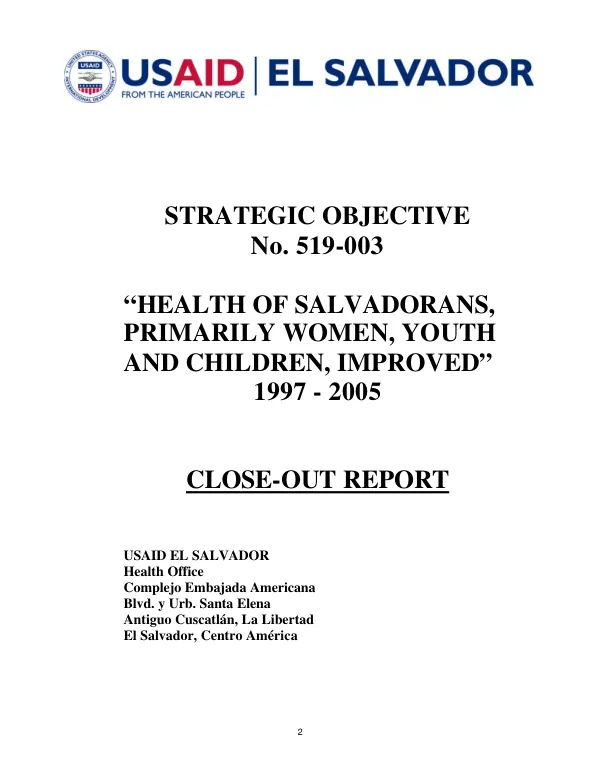
Strategic objective no. 519-003 : 'health of Salvadorans, primarily women, youth and children, improved' 1997-2005 -- close-out report
Open record 1970
1970USAID DEC
![Project assistance completion report : cooperative agreement no. 519-A-00-99-00016-00 with CARE International El Salvador, under the project no. 519-0447 : MAREAS (Mitch actividades de rehabilitacion de emergencia en agua y saneamiento) [Hurriance Mitch emergency rehabilitation activities for water and sanitation]](https://covers.devme.ai/gen/26965.webp)