URBAN INSTITUTE (UI)
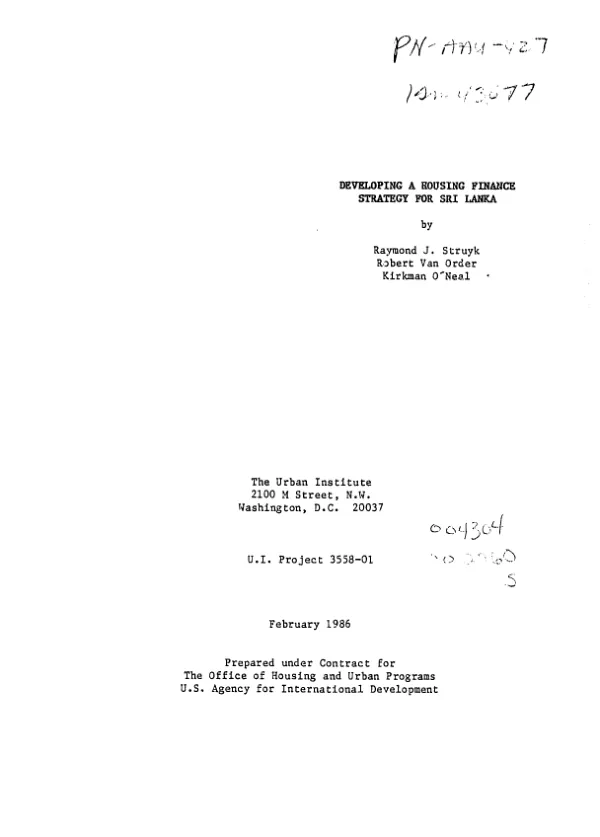
Developing a housing finance strategy for Sri Lanka
This monograph extends and updates the estimates, generated by the Housing Needs Assessment (HNA), of housing needs in Sri Lanka over the period 1983-2003.
Struyk, Raymond J.; Van Order, Robert +1 more · 1986
Sign in to readA free account is required to download.
Abstract
While the HNA estimated the total resources needed by the housing sector over a 20-year period, the application of the Housing Finance Strategy in this paper focuses on how the resources needed in the first five years can best be mobilized and deployed. The update HNA estimated that an annual investment of 7.8 billion rupees (Rs.) would be required to satisfy Sri Lanka"s needs for new and upgraded housing. Actual housing investment in 1985 was estimated at Rs. 5.3 billion, leaving an investment gap of Rs. 2.5 million. The authors suggest that Rs. 1.5 billion of this can be supplied through savings, informal financing, and expansion of the government"s Million Houses Program, leaving a target of Rs. 1 billion which must be generated by increased formal financing. The monograph describes both short- and long-run changes in financial market operations that would enhance the mobilization of these resources without distorting the market or eliminating existing mobilization mechanisms. In addition, the Housing Quality Simulation Model is used to analyze the impacts of three alternative policy reform scenarios. The analysis clearly indicates that the most appropriate direction for Sri Lanka"s housing policy is a complementary mix of private market-rate financing and the expanded use of the Million Houses Program. However, such a program would require several financial reforms, reforms which the Government is unlikely to undertake if its budget deficits remain very large, thereby making continued tight control of financial markets essential. In the event that additional resources for housing do become available, the report makes recommendations as to their most judicious use. (Author abstract, modified, from PN-AAV-887, p.30.)
Related documents