USAID DEC
Development and field testing of the coconut fiber - burnt rice husk filter for supplying drinking water to rural communities, phase 2, final report
Sign inSOUTHEAST ASIA TECHNOLOGY CO., LTD.
Development and field testing of the coconut fiber - burnt rice husk filter for supplying drinking water to rural communities, phase 2, final report
The results of field tests of a simple, inexpensive, and efficient method of water treatment for rural communities in Southeast Asia.
1970
Sign in to readA free account is required to download.
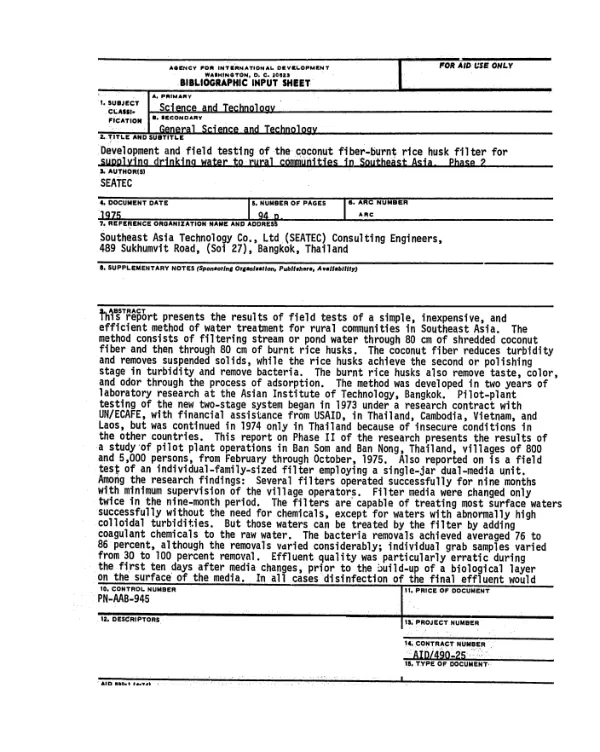
Abstract
The method consists of filtering stream or pond water through 80 cm of shredded coconut fiber and then through 80 cm of burnt rice husks. The coconut fiber reduces turbidity and removes suspended solids, while the rice husks achieve the second or polishing stage in turbidity and remove bacteria. The burnt rice husks also remove taste, color, and odor through the process of absorption. The method was developed in two years of laboratory research at the Asian Institute of Technology, Bangkok. Pilot-plant testing of the new two-stage system began in 1973 under a research contract with UN/ECAFE, with financial assistance from USAID, in Thailand, Cambodia, Vietnam, and Loas, but was continued in 1974 only in Thailand because of insecure conditions in the other countries. this report on Phase II of the research presents the results of a study of pilot plant operations in Ban Som and Ban Nong, Thailand, villages of 800 and 5,000 persons, from February through October, 1975. also reported on is a field test of an individual-family-sized filter employing a single-jar dual-media unit.
Connected topics
Related documents
Documents in this collection
 1970
1970USAID DEC
Transition to an industrial economy in monsoon Asia
Open record 2007
2007USAID DEC