USAID DEC
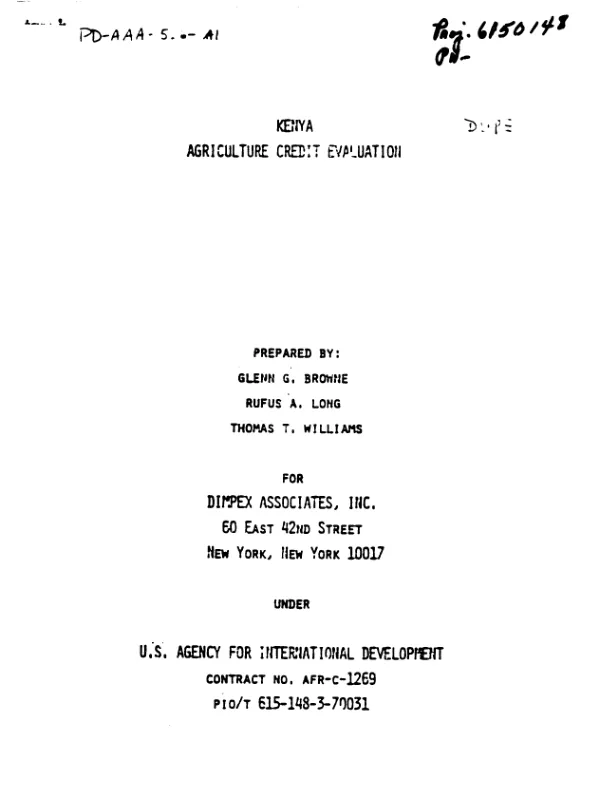
[Development fund for Africa --] impact evaluation of the Kenya agriculture sector loan I project
Sign inDEVELOPMENT ALTERNATIVES, INC. (DAI)
[Development fund for Africa --] impact evaluation of the Kenya agriculture sector loan I project
The Kenya Agriculture Sector Loan I Project was conceived in the mid-1970s to provide Kenya with balance-of-payments support, as the country was experiencing a painful short-term deficit due to the 1973 oil shock.
Deschamps, Jean-Jacques|Castro, Peter · 1989
Sign in to readA free account is required to download.
![[Development fund for Africa --] impact evaluation of the Kenya agriculture sector loan I project](https://covers.devme.ai/gen/8869.webp)
Abstract
The project was designed as a $13.5 million multi-objective sector loan to: (1) finance the production of wheat, maize, and selected cash crops in the 1975-76 planting seasons; and (2) test new approaches for providing smallholders comprehensive production and marketing services over the 1975-78 period. The project was plagued throughout by the serious institutional weaknesses of two of the three implementing financial institutions. The Agricultural Finance Corporation was affected by political interference in lending decisions and by outright corruption. It failed to collect the majority of project-financed loans, and did not develop a capacity to serve its constituency of mostly larger farmers. The Cooperative Bank of Kenya, which was to service smallholders, was dependent on the Ministry of Agriculture for the selection of farmers eligible for credit, and on local cooperative unions and societies for loan management and collection. This disastrous combination also led to very low repayment rates and to a distrust of the system that continued to affect the credit and savings societies as late as 1988. By contrast, the former Kenya Farmers Association was quite successful in managing the $5.3 million of project funds that it directed to its membership of large farmers. The institution's performance under the project is an encouraging -- but all too rare -- example of a financial institution able to maintain high operating and financial performance while dramatically increasing its lending program through access to a donor-sponsored credit fund. The economic benefits of the project were uneven. Without doubt, the large farmers -- particularly those served by the Kenya Farmers Association -- reaped substantial benefits and were able to achieve impressive increases in agricultural production and income. Returns from the loans extended by the Agricultural Finance Corporation were on the other hand disappointing, due to poor borrower selection and misuse of funds. The minority of smallholders who repaid their loans to the Cooperative Bank were in the most part genuinely committed to the adoption of improved agricultural practices hand-in-hand with the application of project-financed inputs. The majority of smallholders who failed to repay their loans ended up receiving what amounted to a one-time grant from the government. It is unclear whether this infusion of cash had a significant impact on production. Since most of the credit was provided in kind in the form of agricultural inputs, application of those inputs presumably led to higher yields the year they were applied. In subsequent years, however, it is likely that most of these farmers reverted to their former practices, thereby receiving few long-term benefits from the project. In any case, economic returns from those unpaid loans pale in comparison to the huge financial cost to the government from non-repayment and costs of managing the entire program. The project's impact on the functioning of rural financial markets was minimal, and was limited to higher income and savings levels achieved by large farmers served by the Kenya Farmers Association. Beyond project-related transactions with the Cooperative Bank, few smallholders actually participated more actively in financial transactions as a result of the project. All in all, the project appears to have in the most part succeeded in boosting short-term production of key agricultural commodities as a result of the loans extended by the Kenya Farmers Association to large farmers. It failed to achieve its second objective, that of enhancing the socioeconomic status of smallholders through the provision of credit and other key services. The key lesson to be learned from this failure to serve smallholders is that A.I.D. should pay much closer attention to institutional capacity and performance at the time of project design. Expectations that a financial institution will clean up its act in the process of handling large amounts of donor-sponsored funds is mere wishful thinking to be avoided at all costs. (Author abstract)
Related documents
![[Development fund for Africa --] impact evaluation of the Kenya agriculture sector loan I project](https://covers.devme.ai/gen/80710.webp)
![[Development fund for Africa --] impact evaluation of the Liberia Lofa County agricultural development project](https://covers.devme.ai/gen/80708.webp)
![[Development fund for Africa --] impact evaluation of the Liberia Lofa County agricultural development project](https://covers.devme.ai/gen/8864.webp)
![[Development fund for Africa --] impact evaluation of the Cameroon credit union development project](https://covers.devme.ai/gen/8871.webp)