USAID DEC
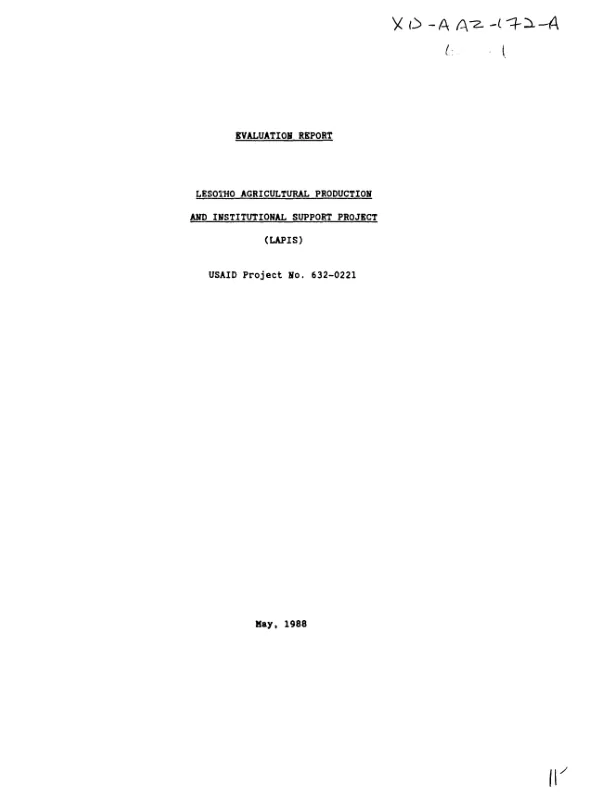
[Development fund for Africa --] impact evaluation of the Lesotho credit union league development project
Sign inDEVELOPMENT ALTERNATIVES, INC. (DAI)
[Development fund for Africa --] impact evaluation of the Lesotho credit union league development project
Ex post evaluation of a project (1980-86) to improve the capability of the Lesotho Cooperative Credit Union League (LCCUL) to provide financial and technical services to its member credit unions.
Gadway, John; Horn, Nancy · 1989
Sign in to readA free account is required to download.
![[Development fund for Africa --] impact evaluation of the Lesotho credit union league development project](https://covers.devme.ai/gen/80709.webp)
Abstract
After 1983, the broad goal of providing LCCUL member unions and their small farmer constituents with improved financial services was replaced with the more limited goal of improving their access to production credit and thereby improving agricultural production practices. The increase in credit availability did not, however, have a great impact on agricultural production practices and in fact contributed to a decline in LCCUL"s self- sufficiency, since most of the small farmer borrowers defaulted on their loans. Neither did the project has a substantial effect on either income distribution or employment opportunities. While training programs and other efforts were undertaken to improve LCCUL"s administrative procedures, these were not sufficient to overcome the project"s problems, and the rate of return to USAID/L"s investment in the project is likely to be negative. Project planners wrongly assumed that capital constraints were the largest barrier to increasing agricultural production in the region and then created a program to meet that non-existing need. In the process, the credit union movement, whose most valuable service actually lay in providing savings rather than credit services, far from expanding, ceased to be a grassroots movement. The same misconception affected the $26 million Agricultural Production and Institutional Support Project (6320221), begun in 1986, which included a component to use LCCUL to channel production credit to small farmers. The project teaches that efforts to increase the amount of credit available to small farmers should not be linked with efforts to upgrade rural financial institutions. Provide the credit through the project directly to the ultimate borrowers or set up a project-based entity, but do not put the savings of poor rural producers at risk by channeling massive amounts of external funds through their institutions.
Related documents
![[Development fund for Africa --] impact evaluation of the Lesotho credit union league development project](https://covers.devme.ai/gen/8866.webp)