USAID DEC
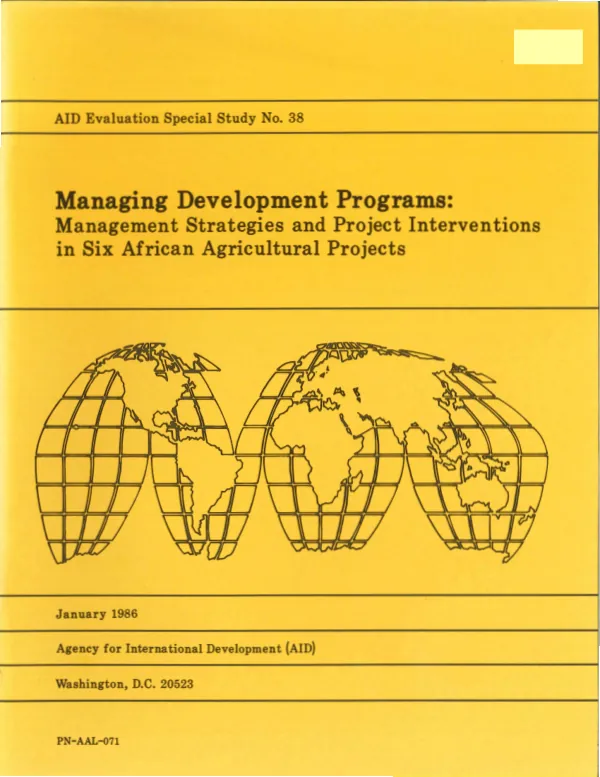
Development management in Africa : context and strategy -- a synthesis of lessons from six agricultural development projects
Sign inUSAID. BUR. FOR PROGRAM AND POLICY COORDINATION. CENTER FOR DEVELOPMENT INFORMATION AND EVALUATION (CDIE)
Development management in Africa : context and strategy -- a synthesis of lessons from six agricultural development projects
The importance of context in development management is the focus of this paper, in which the findings of six A.I.D.
Honadle, George · 1986
Sign in to readA free account is required to download.
Abstract
evaluation case studies of agricultural projects in sub-Saharan Africa are synthesized in light of other academic and field studies of the relative importance of development management and development policy. The author concludes that: (1) management practices can constrain or expand policy effectiveness, just as policies can help or inhibit management; (2) the solution to Africa"s economic crisis lies less with the importation of Western policy and management cures than with appropriate responses developed for the local context; and (3) project performance results from the interaction between management strategy and context. Successful management strategies may have either clear, simple goals or multiple, complex ones, but they must be tailored to a project"s objectives and local setting. In particular, care must be taken to identify who stands to lose and who stands to gain from project success or failure and the risk level for each; when the stakeholders are many and the risk high, multiple and complex objectives may be necessary to deliver benefits to all affected parties. Other key conclusions are: (1) successful management utilizes informal practices and communication channels and benefits from flexible project design; and (2) rigorous financial controls are less important for project performance than is commonly supposed. Regarding the enhancement of indigenous management capabilities, the six projects reviewed showed that bad policies and inadequate organizational structures - not personnel deficiencies - are the main constraints. Thus priority should be given to organization and management assistance, policy reform, and action-oriented training. The specific implications of these findings for project design, management, and evaluation as well as for future research are outlined, and it is noted that the conclusions presented here transcend agricultural projects, and are in fact especially relevant to policy reform and human resource development - both of which focus not on programs alone but on interactions between programs and their contexts.
Related documents
![[Development Fund for Africa --] impact of child survival activities in Africa : a report on AID's progress in reducing infant and child mortality and illness in 17 child survival priority countries](https://covers.devme.ai/gen/8905.webp)