ASSOCIATES FOR INTERNATIONAL RESOURCES AND DEVELOPMENT (AIRD)
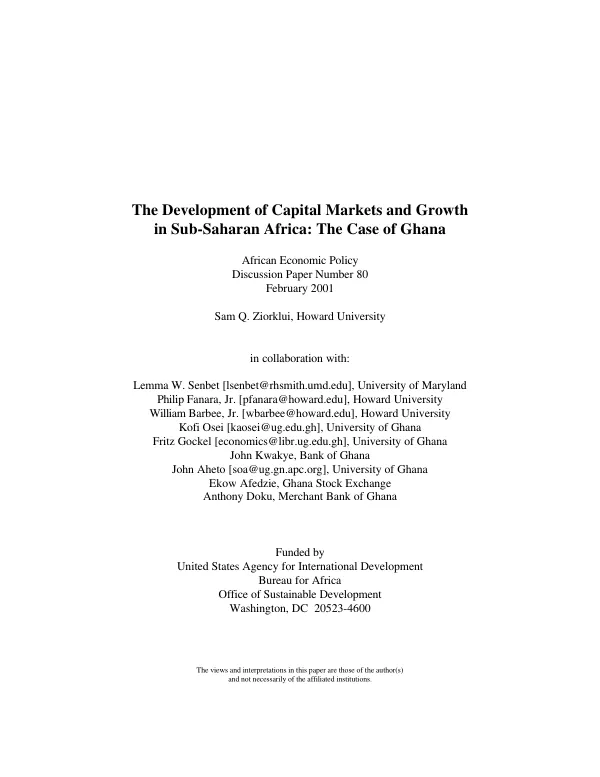
Development of capital markets and growth in sub-Saharan Africa : the case of Ghana
This study identifies constraints to capital market development in Ghana, particularly the underdevelopment of stocks/securities markets and other intermediate financial institutions, and looks at how recent policy changes affect capital market development, growth, and poverty alleviation.
Ziorklui, Sam Q.; Senbet, Lemma W. · 2001
Sign in to readA free account is required to download.
Abstract
Policy, institutional, and structural constraints to capital market development are also explored. Finally, the challenges of regionalizing and globalizing capital markets and the relationship between capital market development and real sector growth in the Ghanaian economy are discussed. The study shows that financial sector reform has addressed some of the major constraints in developing Ghana"s capital market. The government"s commitment to a comprehensive structural and financial sector reform has begun to bear useful results. The restructuring of the banking sector and the liberalization of interest rates have strengthened the banking sector as a competitive sector that complements financial institutions" mobilizing and allocating credit to the productive sectors of the economy. The policy environment has been greatly improved by various initiatives to liberalize the foreign exchange market, privatize state-owned public enterprises, and develop a market-based economy. Among the visible policy change successes are the Ghana Stock Exchange"s (GSE) active role in raising international capital and its active secondary market performance. The GSE"s spectacular performance has attracted Wall Street and other foreign institutional and individual investors to the market. Major challenges remain, however. These include, among others, fiscal deficits that have lead many potential investors to hold short-term government Treasury bills, resulting in a "crowding out" of small and medium-sized enterprises from the capital market; failure to increase credit allocation to the private sector, especially to small and medium-sized enterprises, perhaps due to stringent requirements imposed by prudential regulation of bank loans; a lack of product innovation and a limited number of investment instruments being traded on the stock exchange; the poor quality of accounting information and disclosure by listed firms; inflation and high interest rates; the thinness of the market and the limited number of shares traded on the stock exchange; a market structure that makes it difficult for small and medium-sized firms to raise capital; the absence of investment banks, underwriters, and venture capital firms; the government"s divestiture programs, which emphasize privatization through strategic investor financing rather than through the stock exchange; the discrepancy between listed firms and the country"s main economic activities; and the need to modernize trading and settlement arrangements and technical skills in the industry. Includes recommendations and references.
Related documents