UNIVERSITY OF ILLINOIS AT URBANA-CHAMPAIGN. DEPT. OF ENTOMOLOGY
DEVELOPMENT OF ENVIRONMENTALLY ACCEPTABLE REPLACEMENT FOR DDT
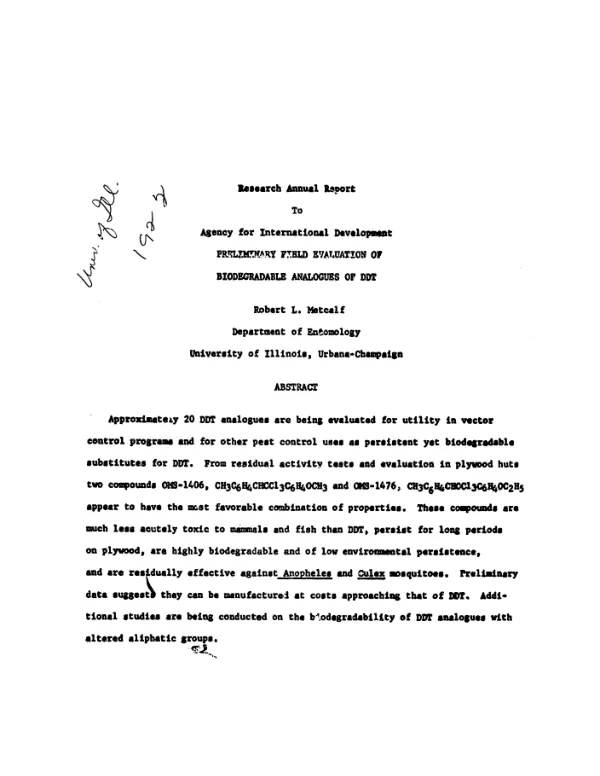
A total of 130 analogues of DDT were synthesized and investigated as "environmentally acceptable replacements for DDT."
1970
Sign in to readA free account is required to download.
Abstract
This paper summarizes research methodology and results, including numerous data tables. Extensive studies of structure vs. activity, of quantitative evaluation of toxicity to susceptible and resistant house fly, black blow fly, and Culex pepiens quinquefasciatus and Anopheles albimanus resulted in selection of a number of the most promising compounds. These were evaluated further for biodegradability and for feasibility and ease of synthesis. Kilogram quantities of some compounds were made and are being further evaluated in several laboratories. The most promising compounds selected for intensive study were OMS-1715 (DECP) of 1, 1-bis-(p-ethoxypheny)-chloropropane and OMS-1856 (DEIB) or 1-(p-ethoxphenyl)-1-(p-tolyl)-2,2,2-trichloroethane, with methoxychlor, and with DDT. Both DECP and DEIB showed long-lasting residual toxicity when applied to plywood surfaces or in plywood huts for knockdown and kill of Anopheles albimanus. DEIB was selected as the most generally suitable insecticide as it is only one-tenth to one-fiftieth as toxic as DDT to laboratory animals and contains no chlorine. It was concluded that it could be used in a variety of insect pest management programs without being deleterious to environmental quality.