USAID DEC
Development planning-oriented simulation model of the agricultural economy of Southern Nigeria
Sign inMICHIGAN STATE UNIVERSITY
Development planning-oriented simulation model of the agricultural economy of Southern Nigeria
A preliminary model of the agricultural economy of southern Nigeria is described.
Abkin, Michael H.; Manetsch, T. J. · 1970
Sign in to readA free account is required to download.
Abstract
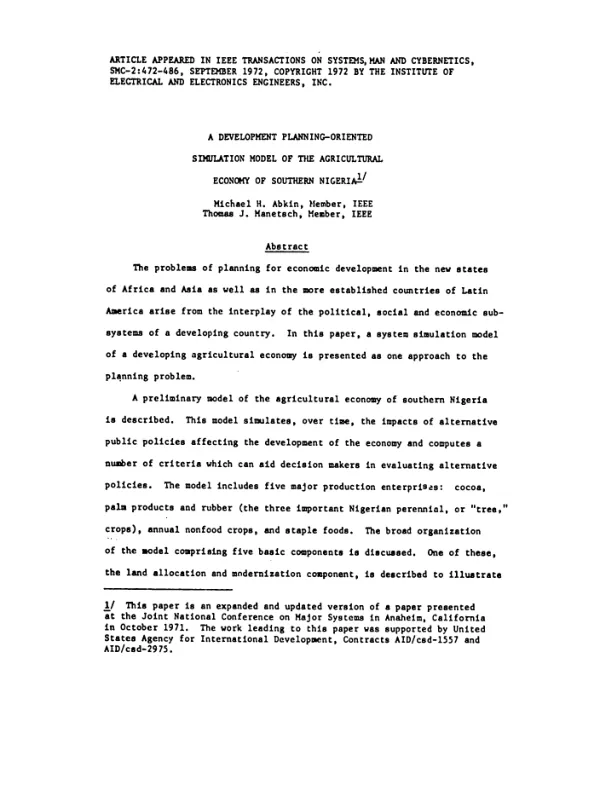
This model simulates, over time, the impacts of alernative public policies affecting the development of the economy and computes a number of criteria which can aid decision makers in evaluating alternative policies. The model includes five major production enterprises: cocoa, palm products and rubber (the three important Nigerian perennial, or "tree" crops), annual nonfood crops, and staple foods. The broad organization of the model comprising five basic components is discussed. One of these, the land allocation and modernization component, is described to illustrate specifically: (1) the distributed parameter model of the perennial production processes which simulates the growth and output of "populations" of trees under alternative development strategies, and (2) the land use transition decision mechanism. Sensitivity analyses and time series tracking against real world data are conducted to tune the model as part of the validation process. Then, with this coarsely validated but still preliminary model, policy runs are made to test the simulated consequences and real world implications for the economy (e.g., gross domestic product, per capita incomes, nutrition, foreign exchange earnings, and so forth) of such policy alternatives as marketing board pricing, taxes and production campaigns. Finally, additional areas for further work are discussed.
Related documents