USAID. BUR. FOR SCIENCE AND TECHNOLOGY. OFC. OF HEALTH
DIATECH -- diagnostic technology for community health
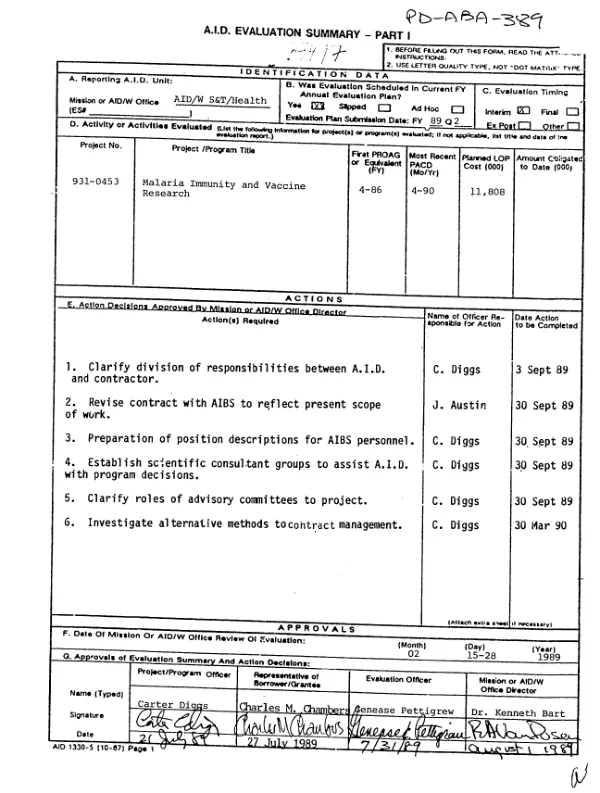
Summarizes midterm evaluation (unattached) of a project to develop simple, cost-effective diagnostic technologies for malaria, diarrheal diseases, and acute respiratory infections.
1990
Sign in to readA free account is required to download.
Abstract
Partners for Technology and Health (PATH) is the project"s chief implementor; subgrant recipients include Johns Hopkins University (JHU) and Queen Saovabha Memorial Institute in Thailand. Evaluation covered the period 10/85 to 6/88. The project has approved 37 research subagreements, but no rapid diagnostic reagent or method for any of the three major diseases has yet been developed. It could be argued that original expectations were not realistic. The project has, however, developed two pieces of diagnostic equipment -- a less expensive field binocular microscope for diagnosis of malaria parasites and bacteria, and a battery-operated Quantitative Buffy Coat Hematology Analyzer for detection of malaria parasites. A Biological Resources Bank (BRB) was established and holds more than 2,000 specimens (primarily of malaria and HIV), data on which are stored on the computerized BIOSTORE database. The project has also developed DiaCat, a technical monograph database containing some 1,700 studies on the treatment, prevention, and epidemiology of infectious diseases; it has been utilized primarily by project staff. A seminar held in Bangkok by PATH on the protection of intellectual property rights was (1) premature, since no diagnostic procedures have yet been developed for marketing, and (2) inconvenient for A.I.D. staff and other project-funded researchers. The project also conducted a comparative evaluation of five commercial rapid blood testing AIDS kits in Kinshasa, Zaire. It was designated as TA, although its subject matter was outside the orginal objectives of the project"s design. It is recommended, inter alia, that the possibility of expanding JHU"s role in the project be explored.