PLANNING AND DEVELOPMENT COLLABORATIVE INTERNATIONAL, INC. (PADCO)
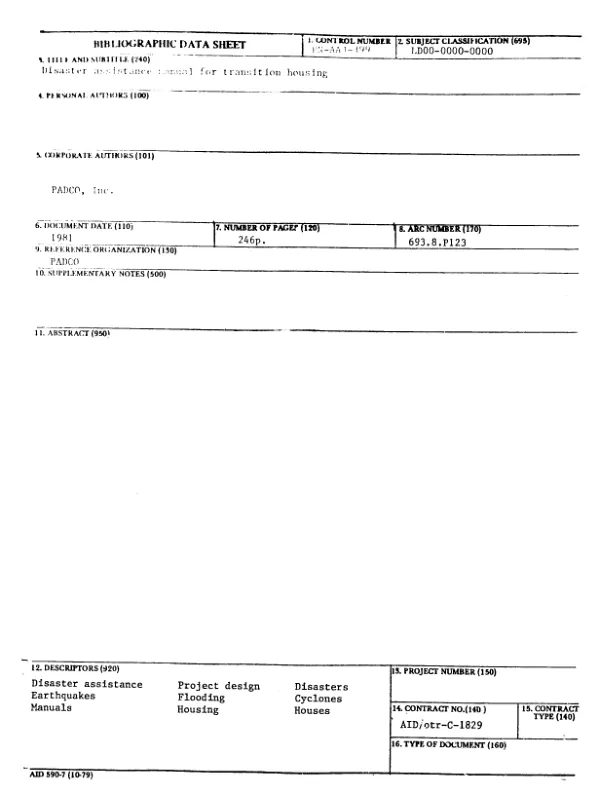
DISASTER ASSISTANCE MANUAL FOR TRANSITION HOUSING
Following a disaster, A.I.D.
1970
Sign in to readA free account is required to download.
Abstract
often provides housing both to meet victims" immediate shelter needs and to create a base from which to reconstruct permanent housing. This manual for A.I.D and host country disaster assistance and housing officials focuses on expeditious planning and implementation of conventional, contractor-built, low- and middle-income, transitional housing. Emphasis is placed on A.I.D."s potential contribution and lessons learned from past experience in the following areas: (1) disaster assessment; (2) operational responsibility; (3) project beneficiaries; (4) project timing; (5) environmental considerations; (6) land ownership and financing; (7) site, selection, location, layout, and access; (8) phased occupancy and implementation of infrastructure; (9) safe housing program components; (10) cyclone-, flood-, and earthquake-resistant design; and (11) project management and evaluation. A.I.D. can make the greatest contribution in the areas of supply procurement, quality control, project oversight, training, site preparation, and information sharing and by assisting the disaster victims prior to project start-up. In conclusion, the author cautions that contractor-built housing -- not always the type of post-disaster assistance preferred by A.I.D. -- may not be the best strategy for providing transitional, post-disaster housing, since such shelter can by its very nature serve only a limited number of victims and meet only a small portion of their total post-disaster needs. The author also points out that implementing such a housing project should not preclude providing post-disaster assistance to other sectors. In addition, care must be taken to plan for the staged occupation of the housing site and for beneficiary relocation, as well as for providing basic infrastructure and services. Appendices include a discussion of core housing and progressive upgrading, building guides for A.I.D. reconstruction projects, an investigation of recipients" views of finance systems, a housing project budget estimation form, a list of 37 organizations and 14 journals in the field of relief and development, and a 17-item general bibliography (1973-80). Additional references are included with each chapter.