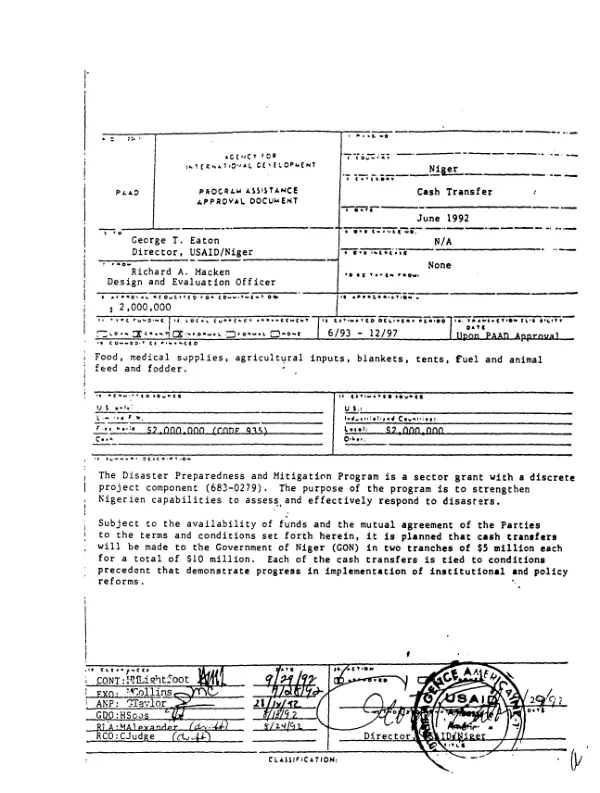
USAID. MISSION TO NIGER
Disaster preparedness and mitigation
Project to support a program (6830271) to strengthen the Government of Niger"s (GON"s) capacity to assess and respond to disasters.
1992
Sign in to readA free account is required to download.
Abstract
The project will provide TA in establishing disaster related procedures and activities, commodities, training, logistical support, and studies, and it will finance replicable pilot disaster mitigation activities and support to the Directorate of Crop Protection (DCP). An institutional contractor will field a long-term TA team to consist of four specialists: a financial management and administration specialist to manage the Emergency Fund being established under the program, and a disaster operations specialist, an early warning and data collection and analysis specialist, and a program development specialist to provide direct TA to the Systeme d" Alerte Precoce (SAP), the GON"s organizational base for disaster response. A variety of short- term TA will be provided as well. The project will finance a mix of in-country, regional, and overseas, short-term training. In-country, there will be workshops, seminars, conferences, training sessions, and study tours for GON officials at the arrondissement, department, and national levels on such topics as data collection, processing and utilization, rapid rural appraisal, emergency planning, program development, operations management, and monitoring and evaluation. A key concept that will be stressed in all in- country training is the need to involve local populations in decisionmaking and disaster response activities. Out of country, mid-level managers will attend workshops, seminars, and study tours in the Sahelian region, and one or two senior staff a year will be sent overseas for specialized training. The project will also fund a series of studies that will facilitate program implementation. Possible subjects include: the impacts of disaster assistance; the assessment of production and consumption; cost-benefit and sustainability assessments of land reclamation using self-help and Cash for Work/Food for Work (CFW/FFW) models; grain loss during milling; disaster vulnerability among pastoral populations; and the organizational and financial status of the DCP. Six pilot activities will test the viability and effectiveness of various mitigation approaches. Possible activities include: (1) provision of subsidized cotton seed or fortified crop residue to herders" associations and pastoral groups; (2) small village-level, FFW projects; (3) CFW/FFW projects to maintain farm-to-market roads; (4) village-level seed loan programs; (5) well digging and deepening projects; and (6) soil and water conservation projects. The project will also continue USAID/N"s institutional support of the DCP.
Related documents