UNIVERSITY OF NORTH CAROLINA AT CHAPEL HILL. SCHOOL OF MEDICINE. PROGRAM FOR INTERNATIONAL TRAINING IN HEALTH (INTRAH)
Dominican Republic performance improvement project evaluation
In 1998, the Performance Improvement Approach (PIA) of the Primary Providers" Training and Education in Reproductive Health (PRIME) project was pilot tested at the Dominican Social Security Institute (IDSS).
Luoma, Marc; Jaskiewicz, Wanda · 2000
Sign in to readA free account is required to download.
Abstract
PIA is a methodology, adapted from successful use in business, used to identify gaps in primary care provider performance, the root causes of those gaps, and interventions to remedy the problem causes. With TA from PRIME, IDSS PIA team members identified performance indicators for family planning/reproductive health (FP/RH) providers at hospitals, clinics, and physician offices. Baseline data were gathered to determine the actual level of performance, using these same indicators. Root causes were uncovered for performance problems, and an array of interventions was designed to address them. After prioritizing interventions, a controlled operations research (OR) design was chosen to determine the effects of alternate intervention combinations on quality of care (QOC) and provider performance, and whether lower cost interventions could have adequate effects without higher cost interventions. Three provinces were selected to test the array of interventions. San Cristobal received the full set of interventions, which included RH training for providers, expectation setting by IDSS headquarters, client feedback, and dissemination of educational materials. La Romana received only expectation setting, client feedback, and educational materials. La Vega served as a control area and did not receive any intervention. Early results indicate that, where the full package of interventions was applied, provider performance has improved significantly over baseline levels. In areas where simple interventions were applied, performance has not increased significantly. The nature of these interventions (e.g., feedback systems) may require more time before performance changes are noted. The short intervention time allowed between baseline and follow-up make the results informative, but inconclusive. Longer-term follow-up should provide more compelling results. During follow-up interviews, local participants found the PIA useful and praised its participatory and systematic nature. The IDSS management plans to expand the interventions used during this pilot nationwide. (Author abstract, modified)
Related documents
Documents in this collection
 1970
1970USAID DEC
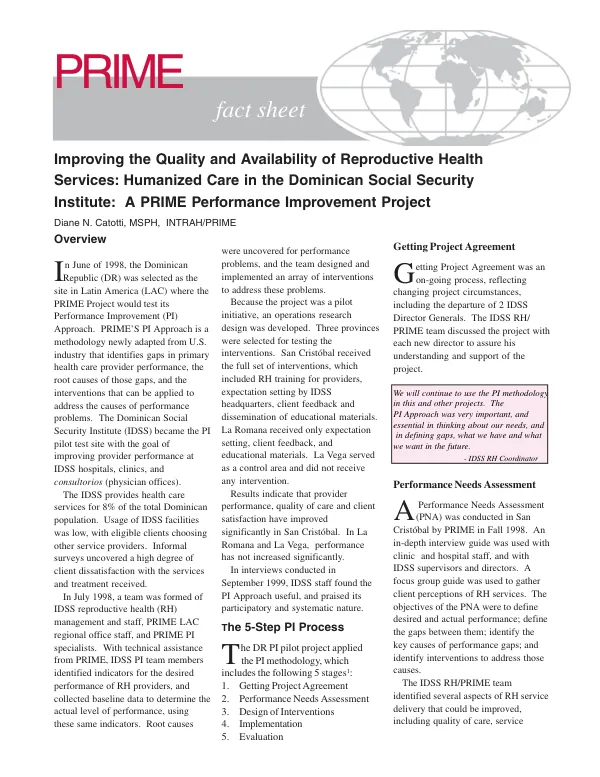
Improving the quality and availability of reproductive health services : humanized care in the Dominican Social Security Institute : a PRIME performance improvement project
Open record 2000
2000USAID DEC