MANAGEMENT SYSTEMS INTERNATIONAL, INC. (MSI)
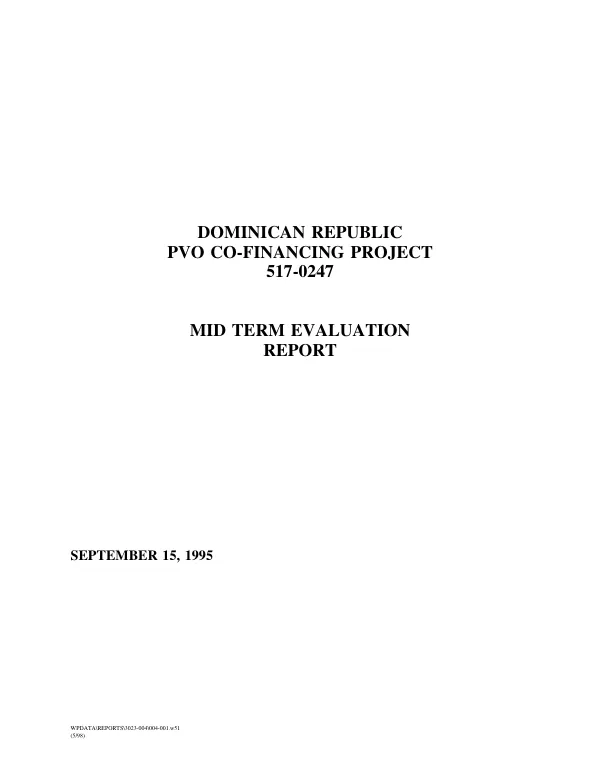
Dominican Republic PVO co-financing project, 517-0247 : mid-term evaluation report
Evaluates project to increase the capacity of Dominican PVOs and NGOs to deliver services and other resources to the poor in USAID/DR's strategic objective areas.
Swanson, Donald|Popper, Roger · 1995
Sign in to readA free account is required to download.
Abstract
Mid-term evaluation covers the period 9/89-5/95. The project is roughly 50% complete, and on track in terms of resource allocation. Of the 35 planned subproject grants, 18 have been awarded in such areas as job training, health, potable water and sanitation, and income and employment generating opportunities to reduce poverty. Of the 400,000 planned beneficiaries, 200,000 have been reached; and 20 of the 30 planned NGOs have received help in project preparation and implementation and financial, and administrative issues. The project supports the majority of USAID/DR strategic objectives, and all subprojects reach the very poor, with five designed exclusively for women. A system for subgrant development design, technical analysis, and financial management is in place, and some training and TA have been provided to PVOs. Rigorous and fair (albeit time-consuming) criteria, surveys, and procedures have been set up for selecting and awarding subproject grants. The whole process has had a salutary effect on participating NGOs' capability to design subprojects and prepare grant applications. All three institutional units (Project Management Unit, ENTRENA, Banco de Desarrollo Dominicano) function well within the context of their specific and limited contracts, and coordination among the three is good. Some of the assumptions in the very general original logical framework are not accurate. NGOs did not have the management capabilities assumed, do not have sufficient resources to provide counterpart contributions, and the larger and more established NGOs are not willing to assist smaller ones with project preparation and administration. Incorrect assumptions have had a minor effect on the project, and have not necessitated design modifications. Another potential problem is that national NGOs do not appreciate what they perceive as harsh new USAID/DR guidelines which include not financing vehicle acquisitions and the requirement that NGOs find 50% counterpart financing elsewhere. In addition, progress towards achieving sustainability is spotty; many NGOs use inefficient and ineffective service delivery systems, and there is a significant possibility that the majority of the service delivery systems will weaken or even disappear after the PACD. As a result, some community participants feel that the communities themselves must be strengthened so they can carry out activities once the project is terminated.