USAID DEC
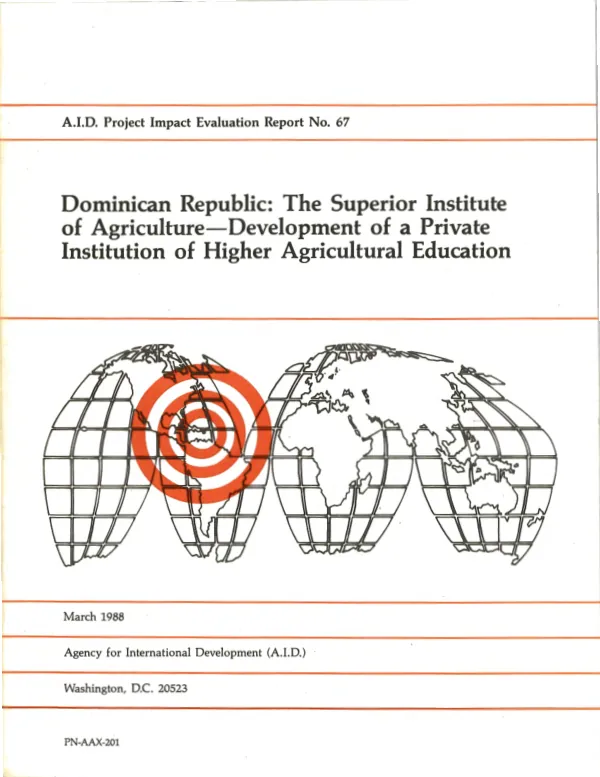
Dominican Republic : the Superior Institute of Agriculture - development of a private institution of higher agricultural education
Sign inUSAID. BUR. FOR PROGRAM AND POLICY COORDINATION. CENTER FOR DEVELOPMENT INFORMATION AND EVALUATION (CDIE)
Dominican Republic : the Superior Institute of Agriculture - development of a private institution of higher agricultural education
The Superior Institute of Agriculture (ISA) was created in 1962 by a group of socially minded community leaders to remedy the Dominican Republic's lack of trained agricultural manpower.
Hansen, David O.|Antonini, Gustavo A.|Strasma, John · 1988
Sign in to readA free account is required to download.
Abstract
Originally a high school, ISA was later expanded to include an undergraduate degree program through a local university, as well as a specialized non-degree program in rural development administration. It recently gained autonomous university status. This report focuses on ISA's development impact. These impacts have been numerous and important. ISA's training is generally regarded as excellent. Current and former faculty are vitally involved in national decisionmaking regarding agricultural and rural development, either indirectly (via research) or directly (via government employment or consultation). ISA faculty have conducted innovative commodity research which has led to important foreign exchange savings and have influenced government policy on critical issues such as agrarian reform and reforestation. Several factors account for ISA's vitality: continuous, strong leadership from its founding group; early institution-building inputs by Texas A&M University; responsiveness to societal needs; innovative training and other programs funded by the Dominican Secretariat of Agriculture (DSOA), A.I.D., and other donors; and ISA's own commitment to quality education. Constraining factors include an overly theoretical curriculum, insufficient linkages with research and outreach activities, and pressures on ISA to turn to the private sector in the light of dwindling government/donor support (which threatens to divert ISA's attention from the small-farm sector) and to reduce or terminate its technical/vocational program (despite the present shortage of lower- and mid-level agricultural technicians). Lessons learned include the following. (1) An agricultural college needs strong, supporting linkages to its primary bureaucratic constituency (in this case, the DSOA). (2) Donors should follow institution-building efforts with projects to build linkages to research and outreach. (3) Moderate resource scarcity can generate institutional entrepreneurship and innovation. (4) External funding should not infringe on the recipient's basic institutional autonomy, which may be a major impetus to social relevancy. (5) Institutional autonomy needs to be coupled with direct accountability to ensure responsiveness to societal needs; oversight by the founding group is an important mechanism in this regard. A 15-page Spanish/English bibliography is included among the appendices. (Author abstract, modified)
Related documents