USAID DEC
Drought and the development of Sahelian economics, a case study of Hausa - Tuareg interdependence
Sign inUNIVERSITY OF WISCONSIN AT MADISON
Drought and the development of Sahelian economics, a case study of Hausa - Tuareg interdependence
With the return of relatively good rains in 1974 in the countries of Sahelian West Africa, development economists, aid agencies, and local governments can look beyond the immediate problems of drought relief; they can begin to plan programs for reconstruction and development.
Baier, Stephen; King, David J. · 1970
Sign in to readA free account is required to download.
Abstract
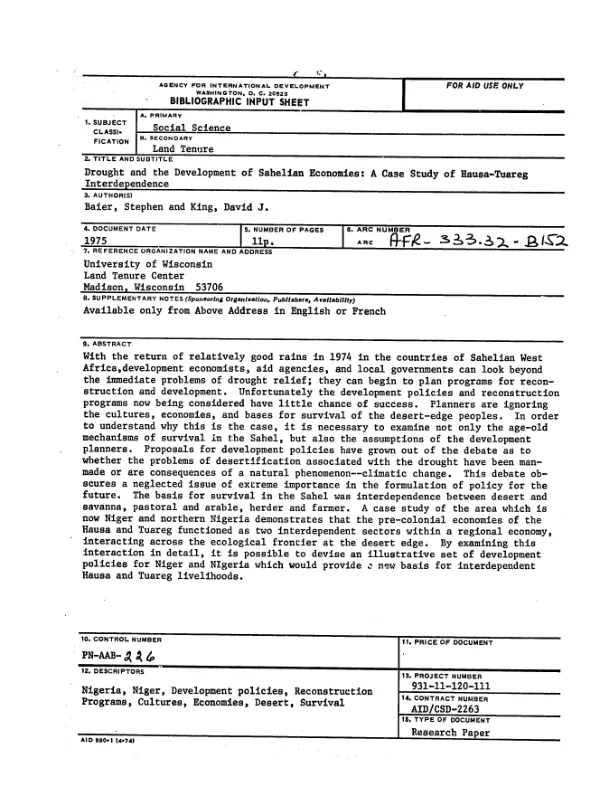
Unfortunately the development policies and reconstruction programs now being considered have little chance of success. Planners are ignoring the cultures, economies, and bases for survival of the desert-edge peoples. In order to understand why this is the case, it is necessary to examine not only the age-old mechanisms of survival in the Sahel, but also the assumptions of the development planners. Proposals for development policies have grown out of the debate as to whether the problems of desertification associated with the drought have been man-made or are consequences of a natural phenomenon -- climatic change. This debate obscures a neglected issue of extreme importance in the formulation of policy for the future. The basis for survival of the Sahel was interdependence between desert and savannah, pastoral and arable, herder and farmer. A case study of the area which is now Niger and northern Nigeria demonstrates that the pre-colonial economies of the Hausa and Tuareg functioned as two interdependent sectors within a regional economy, interacting across the ecological frontier at the desert edge. By examining this interaction in detail, it is possible to devise an illustrative set of development policies for Niger and Nigeria which would provide a new basis for interdependent Hausa and Tuareg livelihoods.
Related documents