USAID. MISSION TO BOLIVIA
Drug awareness and prevention project
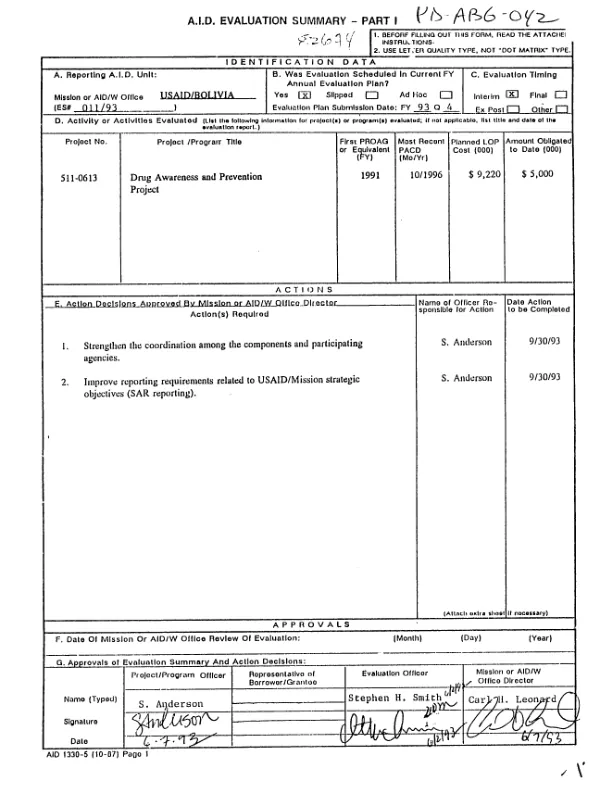
Summarizes interim evaluation (XD-ABG-042-A) of project to increase public awareness in Bolivia of the dangers posed by the cocaine industry.
1993
Sign in to readA free account is required to download.
Abstract
The evaluation covers the period 1991-6/93. The project is being implemented by: (1) the Educational System for Social Mobilization Against Drug Addiction (SEAMOS), a private group; (2) the Narcotics Education Center (CESE), formerly part of the U.S. Embassy, now an independent NGO; (3) the Subsecretariat for Alternative Development (SUBDESAL); and (4) the Project for Research and Awareness in the Prevention of Drug Abuse (PROINCO), a part of Bolivia"s National Directorate against Illegal Drug Use and for Treatment, Rehabilitation, and Social Reinsertion (DINAPRE). Significant progress has been made. SEAMOS, whose image is critically important to the project, has been substantially strengthened and expanded. The information center is operating very effectively, and SEAMOS has met its initial goals in mobilizing and assisting departmental and local organizations. In doing so, it has functioned as a "service provider" to these organizations instead of a builder of a national anti-drug network. SEAMOS maintains cordial relationships with the other participants, but has not sought to become involved in collaborative programs. CESE has experienced success with its telephone hotline, which has exceeded annual goals for responses to drug users, their friends, and family. Less positively, CESE is using a U.S. made video of case study of drug abuse, which could be taken to suggest that the drug problem is external to Bolivia; Bolivian materials should be substituted. Also, due to lack of funding, time, and interest, CESE has not conducted the planned postgraduate training program at the Universidad Catolica Boliviana or the cooperative program with SEAMOS to train promoters in Chapare. As a newly independent NGO, CESE has had difficulty with the administrative procedures and financial controls imposed by the project. Funding delays from the Government of Bolivia have negatively affected the work of the two GOB agencies. Both agencies have capable and impressive staff, and PROINCO"s task accomplishment has been good. The funding delays are unacceptable and immediate action should be taken. Overall, lack of coordination has been the major stumbling block. The project goal is not as compelling to the participating organizations as are their individual goals. There is duplication and overlap of activities. Having only one coordinating mechanism -- a monthly executive meeting -- limits the amount of sharing that can be done. Also, participants have given up too easily in the face of coordination difficulties. The key action decision is to take steps to improve coordination among project components and participating agencies.